
The cybersecurity field is more critical and more lucrative than ever. With digital threats evolving at an unprecedented pace, the demand for highly skilled, certified professionals has skyrocketed. But not all certifications are created equal. Securing the right credential can dramatically accelerate your career trajectory and significantly boost your earning potential.
This guide cuts through the noise to focus on the qualifications that truly matter. We'll delve into the 7 highest paying cyber security certifications for 2025, providing a roadmap for experienced professionals aiming for the industry's top-tier roles and salaries. This is not a list for beginners; it is a strategic overview of the credentials that command the highest respect and compensation.
Inside, you will find a detailed breakdown of each elite certification, including:
- Average Salary Ranges: Realistic earning potential based on current market data.
- Target Audience & Prerequisites: Who each certification is for and what you need to qualify.
- Associated Career Paths: The specific senior-level roles these certifications unlock.
- Exam & Maintenance Insights: Practical details on what it takes to earn and keep the credential.
We will analyze top-tier qualifications like the CISSP and its advanced concentrations (ISSAP, ISSMP, ISSEP), the strategic SABSA framework, the expert-level SANS GSE, and the audit-focused CISA. Understanding these elite certifications is the first step toward claiming your place among the industry's highest earners.
1. CISSP (Certified Information Systems Security Professional)
The Certified Information Systems Security Professional (CISSP) is widely regarded as the gold standard in cybersecurity certifications. Offered by the nonprofit organization (ISC)², it validates a professional's deep technical and managerial competence to design, engineer, and manage an organization's overall security posture. This certification isn't just a technical badge; it's a career-defining credential that signifies strategic security leadership.
Holding a CISSP demonstrates comprehensive expertise across eight critical security domains, including Security and Risk Management, Asset Security, and Security Architecture and Engineering. This broad scope is why it's a frequent requirement for senior and executive-level roles, such as Chief Information Security Officer (CISO), Security Architect, and IT Director. Its prestige and rigorous requirements directly translate into its status as one of the highest paying cyber security certifications available today, with certified professionals often commanding salaries from $120,000 to over $200,000 annually.
Key Requirements and Career Impact
The CISSP is designed for experienced practitioners, not entry-level professionals. The prerequisites and ongoing maintenance are substantial, reflecting the high level of responsibility associated with the roles it prepares you for.
- Experience Prerequisite: Candidates must have a minimum of five years of cumulative, paid, full-time work experience in two or more of the eight CISSP domains. A relevant four-year college degree can substitute for one year of experience.
- Maintenance: To maintain the certification, holders must earn and submit 120 Continuing Professional Education (CPE) credits over a three-year cycle.
The following chart visualizes the core requirements and earning potential associated with the CISSP certification.
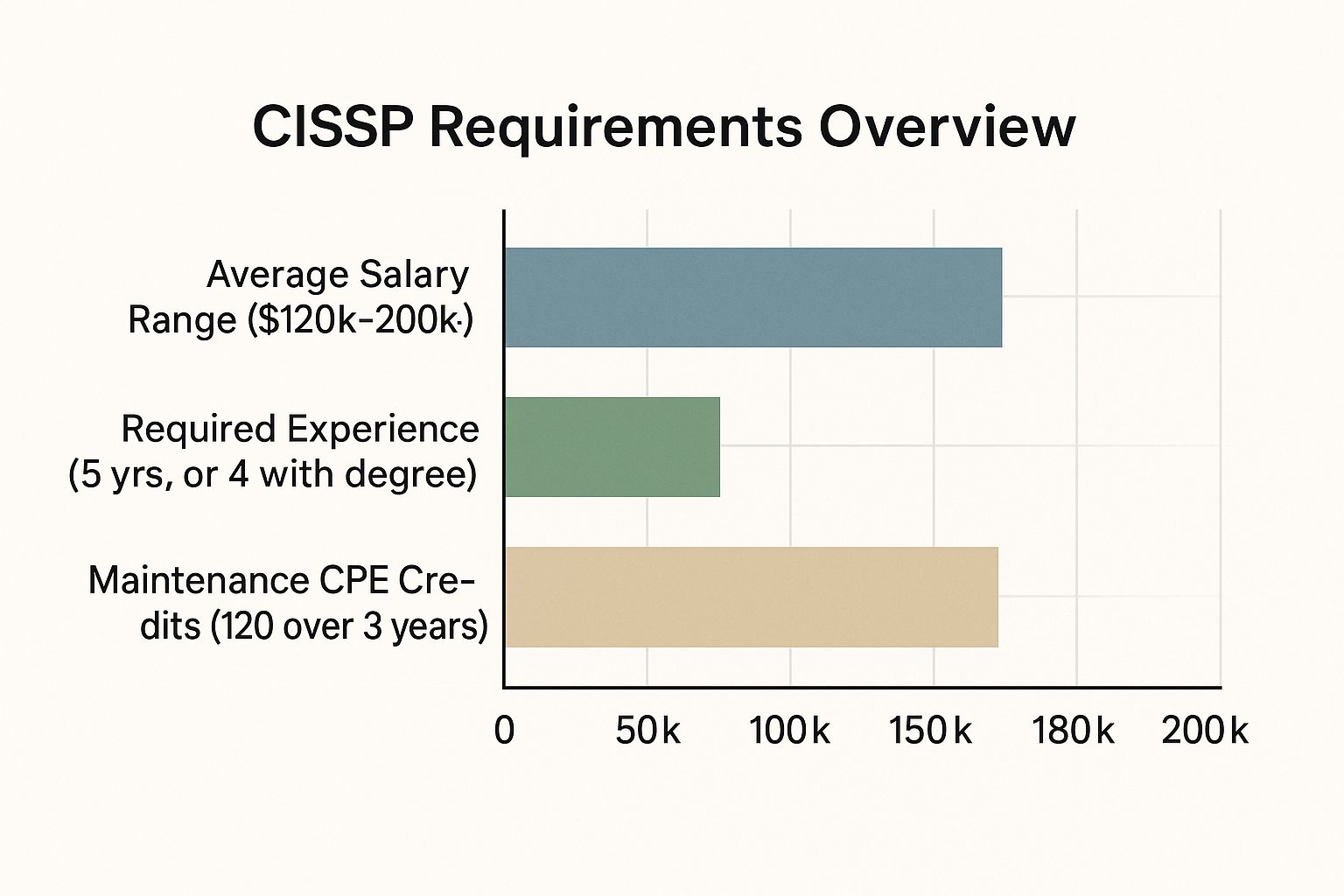
As the chart illustrates, the significant experience requirement is balanced by a high salary potential and a structured professional development path, making the investment in certification highly valuable.
Actionable Tips for CISSP Success
Passing the CISSP exam requires a strategic approach that extends beyond rote memorization. The exam tests your ability to think like a security manager and risk advisor.
- Adopt a Managerial Mindset: The exam is less about hands-on technical configuration and more about security governance, risk management, and strategic decision-making. Always answer from a manager's or advisor's perspective.
- Master the Eight Domains: Use the official (ISC)² study guide as your primary resource. Create a study plan allocating sufficient time to each domain, focusing extra effort on your weaker areas. Plan for 3-6 months of consistent study.
- Leverage Practice Exams: Answering practice questions is crucial for understanding the exam's unique format and style. Utilizing high-quality practice tests can significantly improve your readiness and help identify knowledge gaps. For those preparing for rigorous exams, you can explore the benefits of structured practice tests.
- Join a Study Community: Engage with fellow CISSP candidates through online forums, local study groups, or professional organizations. Discussing complex concepts with peers can provide new perspectives and reinforce your learning.
2. CISSP – ISSAP (Information Systems Security Architecture Professional)
The Information Systems Security Architecture Professional (ISSAP) is a specialized concentration built upon the foundational CISSP credential. Offered by (ISC)², the ISSAP is designed for seasoned security architects responsible for establishing, presenting, and governing secure information system solutions. This certification validates an expert-level ability to develop, design, and analyze security plans and implement security solutions that align with business objectives, making it a pinnacle achievement for security architecture professionals.
Holding a CISSP-ISSAP demonstrates mastery over the entire lifecycle of security architecture, from access control systems to cryptography and physical security integration. This advanced focus is why it's a critical credential for roles like Enterprise Security Architect, Cloud Security Architect, or Senior Security Consultant. The ISSAP's depth and specialization place it firmly among the highest paying cyber security certifications, with certified experts often earning salaries between $130,000 and $220,000 annually.
Key Requirements and Career Impact
The ISSAP is not a standalone certification; it is an advanced concentration for those who have already achieved the CISSP. This prerequisite ensures that candidates possess a broad security foundation before specializing in architecture.
- Experience Prerequisite: Candidates must first be a CISSP in good standing. Additionally, they need a minimum of two years of cumulative, paid, full-time work experience in one or more of the six ISSAP domains.
- Maintenance: To maintain the ISSAP, professionals must earn 20 Continuing Professional Education (CPE) credits annually that are specific to security architecture, in addition to the standard CISSP CPE requirements.
This layered requirement structure ensures that ISSAP holders are not just architects in theory but are proven security leaders with extensive practical experience, justifying their high earning potential and critical role within an organization.
Actionable Tips for ISSAP Success
Passing the ISSAP exam requires a shift from the broad, managerial perspective of the CISSP to a deep, technical, and analytical architectural mindset.
- Master Architecture Frameworks: Gain practical, hands-on experience with established security architecture frameworks like SABSA or TOGAF. The exam expects you to understand how to apply these frameworks to solve complex enterprise security challenges.
- Focus on Business-to-Technology Translation: A key skill for an architect is translating business requirements into technical security controls. Practice designing security architectures for different business scenarios, such as M&A activities, cloud migrations, or IoT deployments.
- Study Security Patterns and Anti-Patterns: Go beyond theory to understand common, effective security design patterns and, just as importantly, common design flaws (anti-patterns). Recognizing these is crucial for both the exam and real-world architectural reviews.
- Leverage Niche Study Groups: Seek out study communities that specifically include ISSAP candidates. Discussing complex architectural problems and design trade-offs with peers who share this specific goal provides invaluable insight that a general CISSP group might not offer.
3. CISSP – ISSMP (Information Systems Security Management Professional)
For those who have already achieved the CISSP, the Information Systems Security Management Professional (ISSMP) concentration is the next logical step toward executive leadership. This advanced certification, also offered by (ISC)², builds directly upon the CISSP foundation, specializing in the skills required to establish, present, and govern an enterprise-wide information security program. It moves beyond general security practices into the realm of strategic management, focusing on leadership, compliance, and business alignment.
The ISSMP is designed for senior-level professionals responsible for managing an organization's security framework. It validates expertise in areas such as Security Leadership and Management, Systems Lifecycle Management, and Contingency Management. Because of this specialized focus on high-level strategy and program direction, it is one of the highest paying cyber security certifications for management-track professionals. Certified individuals often hold roles like Chief Information Security Officer (CISO) or Director of Information Security, with salaries ranging from $125,000 to over $210,000 annually.
Key Requirements and Career Impact
The ISSMP is not an entry point but a capstone for seasoned security leaders. The prerequisites ensure that only those with proven management experience can attain this elite credential, directly impacting its value and the career opportunities it unlocks.
- Experience Prerequisite: Candidates must first hold an active CISSP certification in good standing. Additionally, they need a minimum of two years of cumulative, paid, full-time work experience in one or more of the six ISSMP domains.
- Maintenance: To maintain the ISSMP, professionals must earn 20 Continuing Professional Education (CPE) credits annually that are specific to the ISSMP domains, in addition to the base CISSP requirements.
This dual requirement of a foundational CISSP and specialized management experience solidifies the ISSMP's position as a credential for top-tier security executives. It signals to employers that a candidate possesses not only broad security knowledge but also the demonstrated ability to lead complex security initiatives.
Actionable Tips for ISSMP Success
Success on the ISSMP exam hinges on your ability to think like a CISO, balancing technical realities with business objectives, budgets, and regulatory pressures.
- Focus on Business Case Development: The exam will test your ability to justify security investments. Practice creating compelling business cases for new security programs or technologies, focusing on ROI, risk reduction, and alignment with organizational goals.
- Master Governance Frameworks: Deeply study security governance and control frameworks like COBIT and the NIST Cybersecurity Framework (CSF). Understand how to apply these frameworks to build and measure the effectiveness of a security program.
- Translate Technical Risk into Business Impact: A core management skill is communicating complex technical risks in terms of financial, operational, and reputational impact to non-technical stakeholders. Practice this translation in your study scenarios.
- Develop Security Budgeting Skills: Be prepared for questions related to budget planning, resource allocation, and financial justification. Understand the difference between capital expenditures (CapEx) and operational expenditures (OpEx) in a security context.
4. CISSP – ISSEP (Information Systems Security Engineering Professional)
For professionals who have already achieved the CISSP, the Information Systems Security Engineering Professional (ISSEP) concentration represents a significant step into the specialized world of security engineering. This advanced certification, also offered by (ISC)², was developed in conjunction with the U.S. National Security Agency (NSA) and is tailored for practitioners who apply systems engineering principles to build secure systems. It validates an expert's ability to integrate security into every phase of a system's lifecycle, from initial design to disposal.
The ISSEP moves beyond general security management into the technical and granular aspects of securing complex systems. It is particularly valued in environments where security is non-negotiable, such as in government, defense contracting, and critical infrastructure protection. For this reason, the CISSP-ISSEP is recognized as one of the highest paying cyber security certifications, with certified engineers often earning salaries between $125,000 and $205,000 annually. It signals an elite level of expertise in building security from the ground up, not just adding it on as an afterthought.
Key Requirements and Career Impact
The ISSEP is a post-CISSP specialization, meaning it is designed for seasoned professionals who have already demonstrated broad security expertise. It targets roles like Senior Systems Engineer, Security Architect, and Information Assurance Analyst, especially within organizations adhering to strict U.S. government security protocols.
- Experience Prerequisite: Candidates must first hold the CISSP certification in good standing. This implicitly carries the five-year experience requirement of the CISSP itself.
- Maintenance: To maintain the ISSEP, holders must earn 20 Continuing Professional Education (CPE) credits annually that are specific to security engineering, in addition to the CISSP's regular CPE requirements.
Holding the ISSEP certification demonstrates a mastery of integrating security controls into complex systems, making professionals highly valuable to organizations like the Department of Defense, intelligence agencies, and major defense contractors like Lockheed Martin or Raytheon.
Actionable Tips for ISSEP Success
Success on the ISSEP exam requires a deep understanding of engineering processes and government security frameworks. It tests your ability to think like a security engineer who must balance functionality with robust, verifiable security.
- Master Systems Engineering Lifecycles: Focus your studies on established systems engineering methodologies (e.g., the V-model, Waterfall, Agile) and understand how to embed security activities and checkpoints into each stage.
- Internalize NIST and DoD Frameworks: The exam heavily references U.S. government standards. Deeply study the NIST Risk Management Framework (RMF) found in publications like SP 800-37 and key DoD security engineering instructions.
- Think in Terms of Integration: Shift your mindset from applying security controls to a finished product to integrating security requirements into the system's core architecture. The key is to design security in, not bolt it on.
- Focus on Verification and Validation: Understand the principles of Security Test and Evaluation (ST&E). Be prepared to answer questions about how you would verify that security requirements have been met and how you would validate the system's overall security posture.
5. SABSA (Sherwood Applied Business Security Architecture)
The Sherwood Applied Business Security Architecture (SABSA) is a comprehensive, business-driven methodology and certification framework for enterprise security architecture. Unlike certifications focused purely on technical controls, SABSA provides a structured approach to ensure that security measures are designed, implemented, and managed in direct alignment with an organization's strategic goals, objectives, and risk appetite. This business-first philosophy is what sets it apart and makes it a critical credential for senior security roles.
Holding a SABSA certification demonstrates the ability to translate high-level business requirements into a cohesive and complete security architecture. Professionals with this credential are seen as strategic partners who can build resilient, agile, and cost-effective security programs. This unique skill set is why SABSA is one of the highest paying cyber security certifications, with certified architects and consultants commanding salaries ranging from $115,000 to over $195,000 annually. It is particularly valued in large, complex organizations like financial institutions and government agencies.
Key Requirements and Career Impact
SABSA certifications are structured in a tiered path, allowing professionals to build their expertise progressively. The journey begins with a foundational understanding and advances to master-level proficiency, making it accessible yet rigorous.
- Experience Prerequisite: The initial SABSA Foundation (SCF) level has no formal prerequisites, making it an excellent starting point. However, advanced certifications like the SABSA Chartered Practitioner (SCP) require significant real-world experience in applying the methodology.
- Maintenance: SABSA certifications do not expire and do not have a mandatory CPE requirement, a notable difference from other major certifications. However, continuous learning is highly encouraged to remain effective in the field.
The following chart visualizes the core aspects and salary potential tied to the SABSA certification framework.

As the chart indicates, the framework's focus on aligning security with business needs creates a direct path to high-impact, high-reward roles like Enterprise Security Architect and Security Consultant.
Actionable Tips for SABSA Success
Achieving SABSA certification requires a deep understanding of its framework and the ability to apply its principles to solve complex business problems. Success depends on shifting from a purely technical mindset to a business-centric one.
- Start with the Foundation: Begin with the SABSA Foundation (SCF) course. This five-day course is the official and most effective way to learn the core methodology, terminology, and models directly from accredited trainers.
- Think in Layers and Perspectives: Master the SABSA Matrix, which consists of six layers (Contextual, Conceptual, Logical, Physical, Component, Operational) and six perspectives (What, Why, How, Who, Where, When). Practice mapping business requirements through these layers.
- Apply to Real-World Scenarios: Use the SABSA framework to analyze case studies or real-world security challenges within your own organization. This practical application solidifies your understanding far better than memorization alone.
- Focus on Business Translation: The core skill tested is your ability to gather business requirements and translate them into security architecture deliverables. Practice articulating security needs in terms of business risk, value, and objectives.
6. SANS GIAC Security Expert (GSE)
The GIAC Security Expert (GSE) is the most prestigious and challenging certification offered by the SANS Institute, often considered the Ph.D. of hands-on cybersecurity. Achieving the GSE signifies a practitioner's mastery across a wide array of security disciplines, validated through a series of demanding prerequisites and a rigorous two-day, hands-on lab examination. It is a credential that proves not just what you know, but what you can do under pressure.
This elite certification is designed for top-tier technical experts who can integrate knowledge from offensive, defensive, and foundational security domains to solve complex real-world problems. Its difficulty and the comprehensive skills it validates place it firmly among the highest paying cyber security certifications. GSE holders are sought after for roles like Lead Security Architect, elite penetration tester, and CISO at security-focused organizations, with salaries frequently ranging from $130,000 to over $220,000 annually.

Key Requirements and Career Impact
The path to the GSE is a multi-year journey, not a short-term goal. It is explicitly designed to test the depth and breadth of a cybersecurity professional's practical, applied skills, making it one of the most respected technical certifications in the industry.
- Experience Prerequisite: Candidates must hold at least three GIAC certifications (one from Information Security Foundations, one from Security Administration/Management, and one from Technical Security). Additionally, they must have a background in both offensive and defensive security practices.
- Maintenance: The GSE certification is valid for four years and requires the holder to earn and submit 36 Continuing Professional Experience (CPE) units and successfully retake the two-day hands-on lab exam to recertify.
The GSE’s intense requirements ensure that certified individuals are true experts, capable of leading technical security initiatives and solving the most complex challenges an organization might face.
Actionable Tips for GSE Success
Earning the GSE requires a long-term strategic plan focused on deep, practical skill development rather than just passing multiple-choice exams.
- Plan a Multi-Year Certification Path: The GSE is a marathon, not a sprint. Strategically select your prerequisite GIAC certifications to build a comprehensive skill set covering areas like forensics, incident response, and penetration testing.
- Focus on Hands-On Lab Experience: Go beyond the course material. Set up your own labs, participate in Capture The Flag (CTF) competitions, and constantly practice the skills learned in your GIAC courses. The final exam is entirely hands-on.
- Maintain Detailed Notes and References: SANS exams are open-book. Throughout your prerequisite GIAC studies, build a meticulously organized index of your course books and notes. This indexed library will be your most valuable asset during the exams. To stay sharp on key concepts, many candidates explore how to use flashcards for studying.
- Join a GSE Study Community: Connect with other GSE candidates and existing GSEs. These groups provide invaluable mentorship, shared resources, and practice scenarios that mimic the comprehensive nature of the final lab exam.
7. CISA (Certified Information Systems Auditor)
The Certified Information Systems Auditor (CISA) is the global standard for professionals who audit, control, monitor, and assess an organization's information technology and business systems. Offered by ISACA, CISA validates a professional's expertise in navigating the complex challenges of modern enterprise IT governance, risk management, and compliance. While its core focus is on auditing, the CISA credential is a powerful stepping stone into senior security management and governance roles, bridging the gap between technical controls and business objectives.
Holding a CISA demonstrates proven expertise across five critical job practice domains, including Auditing Information Systems, Governance and Management of IT, and Protection of Information Assets. This comprehensive scope makes it highly sought after in regulated industries like finance, healthcare, and government. Its reputation for rigor directly contributes to its place among the highest paying cyber security certifications, with certified professionals frequently earning salaries between $105,000 and $175,000 annually.
Key Requirements and Career Impact
The CISA is aimed at experienced IT audit, control, and security professionals. The prerequisites are designed to ensure that certified individuals possess not just theoretical knowledge but also practical, hands-on experience in the field.
- Experience Prerequisite: Candidates must have a minimum of five years of professional information systems auditing, control, or security work experience. Certain education waivers can substitute for up to three years of this experience.
- Maintenance: To maintain the CISA certification, holders must earn a minimum of 20 Continuing Professional Education (CPE) hours annually and a total of 120 CPE hours over a three-year cycle.
The CISA is especially valuable for professionals in roles like IT Auditor, Compliance Officer, and Risk Manager. It provides a clear pathway for auditors to transition into lucrative security management positions by equipping them with the language of risk and governance that executives understand.
Actionable Tips for CISA Success
Passing the CISA exam requires a deep understanding of audit processes and the ability to apply risk-based judgment. The exam tests your ability to think like a seasoned IS auditor.
- Master the Audit Mindset: The CISA exam is fundamentally about process, governance, and assurance. Your goal is to evaluate controls, identify risks, and provide recommendations. Always approach questions from the perspective of an independent auditor.
- Focus on the Five Domains: Use the official ISACA CISA Review Manual as your core study resource. Develop a balanced study plan that thoroughly covers all five domains, as the exam is weighted across them. Pay close attention to the relationship between IT governance and audit planning.
- Translate Technical Controls to Business Risk: A key skill tested is your ability to explain the business impact of a technical finding. Practice framing your answers in terms of financial, reputational, or operational risk rather than just technical vulnerabilities.
- Consider Complementary Certifications: While powerful on its own, combining CISA with other credentials can accelerate career growth. For instance, pairing it with vendor-specific knowledge is a common strategy; you can learn more about getting certified to round out your technical and audit expertise.
Top 7 Highest Paying Cybersecurity Certifications Comparison
| Certification / Program | Implementation Complexity 🔄 | Resource Requirements ⚡ | Expected Outcomes 📊 | Ideal Use Cases 💡 | Key Advantages ⭐ |
|---|---|---|---|---|---|
| CISSP (Certified Information Systems Security Professional) | High: Requires 5 years experience, broad domain coverage, peer review | High: Expensive exam and ongoing CPE maintenance | Executive-level cybersecurity roles, high salary potential | Experienced security pros aiming for senior/executive roles | Globally recognized, vendor-neutral, strong ROI |
| CISSP – ISSAP (Security Architecture Professional) | Moderate-High: Requires active CISSP + 2 yrs architecture experience | Moderate: Additional ISSAP CPEs and study time | Specialized security architecture leadership roles | Security architects, cloud/enterprise architecture experts | Premium salary, specialized technical expertise |
| CISSP – ISSMP (Security Management Professional) | Moderate-High: Requires active CISSP + 2 yrs management experience | Moderate: Additional ISSMP CPEs and focused study | Security program leadership and management roles | Security managers, CISOs, enterprise program leaders | Strong business-alignment, leadership validation |
| CISSP – ISSEP (Security Engineering Professional) | High: Requires active CISSP + 2 yrs security engineering experience | Moderate: Additional ISSEP CPEs and technical study | Systems security engineering and secure system design | Government/defense engineers, secure systems developers | Deep technical focus, required in sensitive sectors |
| SABSA (Sherwood Applied Business Security Architecture) | High: Complex methodology covering all architecture layers | Moderate-High: Training investment, ongoing methodology maintenance | Enterprise security architecture aligned with business | Enterprise architects, consulting firms, large orgs | Comprehensive and business-driven framework |
| SANS GIAC Security Expert (GSE) | Very High: Requires multiple GIAC certs, hands-on lab, years of prep | Very High: Expensive GIAC exams, lengthy study, lab passes | Elite technical security expert roles | Top-tier security engineers, consultants, elite specialists | Prestigious, rare, highest technical expertise |
| CISA (Certified Information Systems Auditor) | Moderate: Focused on audit and governance with 5 years experience | Moderate: Exam cost and 120 CPE credits every 3 years | Audit, compliance, governance leadership | Info systems auditors, compliance officers, risk managers | High demand in regulated industries, strong governance focus |
Charting Your Course to a Higher Salary
Navigating the landscape of cybersecurity certifications can feel overwhelming, but as we've detailed, the rewards for choosing the right path are substantial. Investing in one of the highest paying cyber security certifications is more than just a line item on your resume; it's a strategic investment in your professional future, unlocking doors to leadership roles, complex challenges, and significant financial compensation.
The journey through credentials like the foundational CISSP, its advanced specializations (ISSAP, ISSMP, ISSEP), the elite SANS GSE, the business-centric SABSA, and the audit-focused CISA highlights a critical truth: specialization pays. Each certification represents a unique domain of mastery, from high-level security architecture and management to deep-technical, hands-on expertise. The common thread is a commitment to a rigorous, vendor-neutral standard of excellence that employers are willing to pay a premium for.
From Knowledge to Action: Your Strategic Next Steps
Understanding which certifications lead to top-tier salaries is the first step. The next, more crucial phase is turning that knowledge into a concrete action plan. Simply aiming for a certification is not enough; you need a strategic approach to preparation and a clear vision for how it aligns with your career trajectory.
Here are actionable steps to translate your ambition into achievement:
-
Perform a Career Self-Audit: Before committing to a certification path, honestly assess your current skills, experience, and professional goals. Do you enjoy high-level strategic planning (SABSA, ISSMP)? Are you passionate about hands-on technical challenges and engineering (GSE, ISSEP)? Or does governance and compliance excite you (CISA)? Your choice must align with your genuine interests and long-term aspirations.
-
Map Prerequisites and Milestones: Each of these elite certifications has stringent experience requirements. Create a detailed roadmap. If your target is the CISSP-ISSAP, first focus on achieving the CISSP. Document your relevant work experience as you gain it, ensuring it aligns with the specific domains required by (ISC)² or ISACA.
-
Adopt a Modern, Efficient Study Framework: The days of simply reading a textbook cover-to-cover are over, especially for exams of this caliber. Success requires a more intelligent, science-backed approach to learning.
Key Insight: Elite certifications test your ability to apply knowledge, not just recall facts. Your study methods must reflect this. Focus on active recall, scenario-based problem solving, and spaced repetition to move information from short-term to long-term memory.
The Value of Smart Preparation
The financial and time investment for these certifications is significant. A failed exam attempt not only costs money but also delays your career advancement. This is why how you study is just as important as what you study.
Consider the learning principles used by modern, effective training platforms. Tools that incorporate evidence-based techniques can dramatically improve retention and reduce study time. Key methods to integrate into your plan include:
- Spaced Repetition Systems (SRS): Use digital flashcard tools (like Anki or specialized platform features) that present concepts at increasing intervals, forcing your brain to work harder to recall them and cementing them in your memory.
- Active Recall through Practice Exams: Don't just read answers. Actively try to solve problems in a simulated exam environment. This builds mental stamina and exposes your knowledge gaps in a low-stakes setting.
- Analytics-Driven Focus: Leverage tools that track your performance by topic or domain. This allows you to pinpoint your weak areas and dedicate study time where it will have the most impact, rather than wasting time on concepts you've already mastered.
Ultimately, securing one of the highest paying cyber security certifications is a testament to your dedication, expertise, and strategic thinking. By aligning your chosen credential with your career goals and adopting an intelligent, efficient study methodology, you are not just preparing to pass an exam. You are building the deep, applicable knowledge that commands a top-tier salary and positions you as a leader in the critical field of cybersecurity.
While your immediate goal might be a top-tier security credential, the principles of effective study apply to all areas of tech, including foundational cloud skills. If your career path involves cloud development or requires a better understanding of cloud platforms, check out AZ-204 Fast. Our platform uses these same evidence-based learning methods like spaced repetition and practice analytics to help you master the material for the Microsoft Azure Developer certification efficiently. Build a strong foundation for your future at AZ-204 Fast.
Leave a Reply