
So, what exactly is a Python coding bootcamp? Think of it as a high-intensity, accelerated training program that gets you job-ready in Python programming, fast. We're not talking years here; most of these programs run anywhere from 12 to 24 weeks. It's a focused alternative to a four-year computer science degree, cutting straight to the practical skills you need to build real-world projects.
Unpacking the Python Coding Bootcamp Model

Here’s a good way to think about it: a traditional university degree is like a scenic road trip across the country. You'll see a lot, take some detours, and absorb a massive amount of knowledge over a long time. A Python bootcamp is more like a bullet train—it’s built to get you to a very specific, high-value destination as efficiently as possible.
The whole philosophy is built around one simple idea: learn by doing. Forget long, dry lectures on theory. Your days will be packed with hands-on coding, working side-by-side with other students, and building actual, working applications from the ground up. The model intentionally strips away the fluff to zero in on a single, clear goal: making you a hirable developer.
Python Bootcamp at a Glance: Key Considerations
Before diving deeper, it's helpful to have a quick snapshot of what you're getting into. This table breaks down the essential factors to weigh when you're considering a Python bootcamp.
| Factor | Typical Range or Expectation | Why It Matters |
|---|---|---|
| Duration | 12–24 weeks for full-time immersive programs. Part-time options can extend to 6–12 months. | The condensed timeline is a major draw, but it demands a serious commitment. Your personal and professional life needs to accommodate this intensity. |
| Cost | $10,000–$20,000+. Look for financing, scholarships, or Income Share Agreements (ISAs). | This is a significant financial investment. You need to weigh the upfront cost against the potential salary boost and career opportunities. |
| Prerequisites | Varies. Some are beginner-friendly; others require basic coding knowledge (HTML/CSS, JavaScript). | Don't assume you can just sign up. Many programs have an admissions process to ensure you're ready for the fast pace. |
| Curriculum | Core Python, data structures, algorithms, web frameworks (Django/Flask), databases (SQL), and version control (Git). | A strong curriculum should cover both the fundamentals and the tools currently used in the industry to make you job-ready. |
| Career Outcomes | Career coaching, resume help, interview prep, and hiring partner networks. 79% of grads find jobs in their field. | The goal is a job. The best bootcamps don't just teach you to code—they teach you how to get hired. |
Understanding these key points from the start helps you evaluate different programs and find the one that truly fits your career goals and personal circumstances.
Why Is Python the Language of Choice?
It's no accident that so many bootcamps are built around Python. Its simple, almost English-like syntax makes it the perfect first language for someone new to programming. You can start wrapping your head around core concepts like loops and data structures without getting tripped up by complicated rules, which is critical for keeping up momentum in such a fast-paced setting.
But don't let its simplicity fool you—Python is incredibly powerful. It’s the go-to language in some of the fastest-growing sectors in tech, which means bootcamp grads walk away with a versatile skill set they can apply to a ton of different jobs.
- Web Development: Frameworks like Django and Flask are the backbone for countless web applications and backend systems.
- Data Science and Machine Learning: With libraries like Pandas, NumPy, and TensorFlow, Python is the undisputed king of data analysis, AI model building, and visualization.
- Automation: From simple scripts that organize your files to complex programs that manage IT infrastructure, Python is a master of automation.
A coding bootcamp is a career accelerator. It's an intense, structured environment built to compress years of learning into months, equipping you with the specific tools and portfolio projects needed to land your first tech job.
Who Is This Model Designed For?
The bootcamp model is a great fit for a lot of different people, but it’s especially powerful for a few specific groups. It’s a game-changer for career changers—think of marketers, accountants, or healthcare workers who want to break into tech without going back to college for another four years.
It’s also a smart move for people already working in tech who need to add new skills or shift their focus. An IT support specialist, for example, might enroll in a Python bootcamp to get the skills for a more specialized role in data analytics or DevOps. The bootcamp industry has exploded to meet this demand; there are now over 600 coding bootcamps globally. Best of all, they work. An impressive 79% of graduates land a job in their new field shortly after finishing. You can explore more statistics on the bootcamp industry to see just how big of an impact it's having. This structured, results-driven approach is what makes it such a solid investment in your future.
What You'll Actually Learn and Build
Walking into a Python coding bootcamp is less like stepping into a classroom and more like entering a workshop. You're not there to just listen to theory; you're there to get your hands dirty and build things, right from day one. The entire curriculum is engineered to rocket you from the absolute basics to complex, real-world applications at an intense pace.
Your journey starts with the fundamental grammar of Python. Think of it as learning the notes and scales before you try to play a symphony. You have to master the core concepts every single developer relies on, no matter what they end up creating.
Laying the Foundation with Python Fundamentals
First up is Python's syntax—the language's rules. One of the best things about Python is how readable it is, which really helps you pick things up fast. You'll get familiar with variables (the containers for your data), data types (like numbers, text, or true/false values), and operators (the math and logic symbols that get things done).
From there, you'll quickly level up to more structured concepts:
- Control Flow: This is how you give your code a brain. Using
if,elif, andelsestatements, you teach your program how to make decisions and react differently to various situations. - Loops: Repetitive tasks are a programmer's nightmare. You'll learn how to use
forandwhileloops to repeat actions automatically, which is a must-have skill for handling any significant amount of data. - Data Structures: This is where you learn to be a digital organizer. You’ll work with lists, dictionaries, tuples, and sets—each one a specialized tool designed to store and manage data in the most efficient way for the job at hand.
- Functions: Here, you learn the art of writing clean, reusable blocks of code. It's a foundational principle for building applications that are easy to manage and scale.
A bootcamp doesn't just tell you what a "for loop" is. It makes you use one, right now, to solve a real problem. This project-based approach locks in knowledge way better than just passively watching a video.
This initial phase is a sprint. You'll be writing code constantly, tackling small challenges that hammer home each new topic. To keep everything straight, many students find active recall techniques are a lifesaver. In fact, checking out how to use flashcards for studying is a great trick for memorizing syntax when things are moving this quickly.
From Building Blocks to Real Applications
Once you've got the fundamentals down cold, the bootcamp curriculum pivots. You'll start piecing those building blocks together to create much larger applications using the same tools and frameworks the pros use every day. This is where you often get to specialize, diving deep into a high-demand field like web development or data science.
Depending on the bootcamp's focus, your path will fork into a specialized track.
If you focus on Web Development, you will build with:
- Django or Flask: These are the heavy-duty Python frameworks that give you the scaffolding to build secure, powerful web apps. You’ll create the backend systems that manage user accounts, talk to databases, and power websites.
- Databases and SQL: You’ll learn how to properly store, fetch, and manage data using databases like PostgreSQL and the language used to talk to them, SQL.
- APIs: A core skill for any modern developer is making different applications communicate. You’ll build and use APIs (Application Programming Interfaces) to make that happen.
If your path is Data Science, you will master:
- NumPy and Pandas: These two libraries are the bread and butter of data analysis in Python. You'll learn to wrangle massive datasets, clean up messy information, and perform complex calculations in just a few lines of code.
- Matplotlib and Seaborn: Data isn't useful until you can see the patterns. These libraries are your toolkit for creating charts, graphs, and other visualizations to uncover trends and tell a story with your data.
- Scikit-learn: Welcome to machine learning. With this library, you’ll start building predictive models that can forecast sales, classify photos, or even spot fraudulent transactions.
Your Portfolio: The Ultimate Proof of Skill
The real crown jewel of any bootcamp experience is the portfolio you walk away with. You won't just be doing homework assignments; you’ll be building a series of complete, functional projects from the ground up. These aren't just for practice—they are your new professional calling card.
By the end, you might have built a working e-commerce site, a data dashboard that visualizes live information, or a machine learning model that makes accurate predictions. These projects are your resume. They offer employers undeniable proof that you don't just "know" Python—you know how to use it to ship real, valuable products. When you walk into an interview, you'll be able to show them what you can do, not just tell them.
Navigating the Cost and Time Commitment
Alright, let's get down to the two biggest questions on everyone's mind: "How much is this going to cost?" and "How much of my life will this take?" These are the real-deal considerations, so we need to break down the investment—both in dollars and in hours—that a Python bootcamp demands.
It helps to think of the tuition not as a cost, but as a direct investment in your future. Yes, the sticker price can look daunting, but it's designed to rocket you into a high-paying tech career much faster than a traditional degree.
Understanding the Financial Investment
The price tag on a Python coding bootcamp can be all over the map. You'll find programs ranging from more accessible options under $3,000 to premium, all-in experiences that can go up to $25,000. The top-tier programs justify their cost with intensive curricula, one-on-one mentorship, and seriously robust career support.
The good news? Most bootcamps know this is a huge commitment and offer flexible ways to pay. Plus, the return on that investment is often impressive. It’s not uncommon to see graduates in major US markets landing jobs with average salaries around $120,000. If you want to dig deeper into the numbers, you can discover more insights about bootcamp ROI on Nucamp.co.
Here are a few common ways to manage the cost beyond just paying upfront:
- Loans: Many schools have partnerships with lenders like Climb Credit or Ascent that specialize in this kind of education, offering manageable repayment plans.
- Scholarships: The tech industry is actively working to become more diverse. Because of this, you’ll find tons of scholarships for women, veterans, and people from underrepresented groups. Always, always check the financial aid page of any bootcamp you're considering.
- Income Share Agreements (ISAs): This is a popular one. With an ISA, you pay little to nothing to start. In return, you agree to pay a small percentage of your income for a set period after you land a job that pays above a certain amount.
An Income Share Agreement (ISA) is a game-changer because it means the school only succeeds if you succeed. If you don't land a good job, you don't pay. It's the ultimate vote of confidence from a bootcamp in its own program.
This chart gives you a sense of how a well-structured curriculum works, building your skills layer by layer until you're ready to tackle a final project that proves you know your stuff.
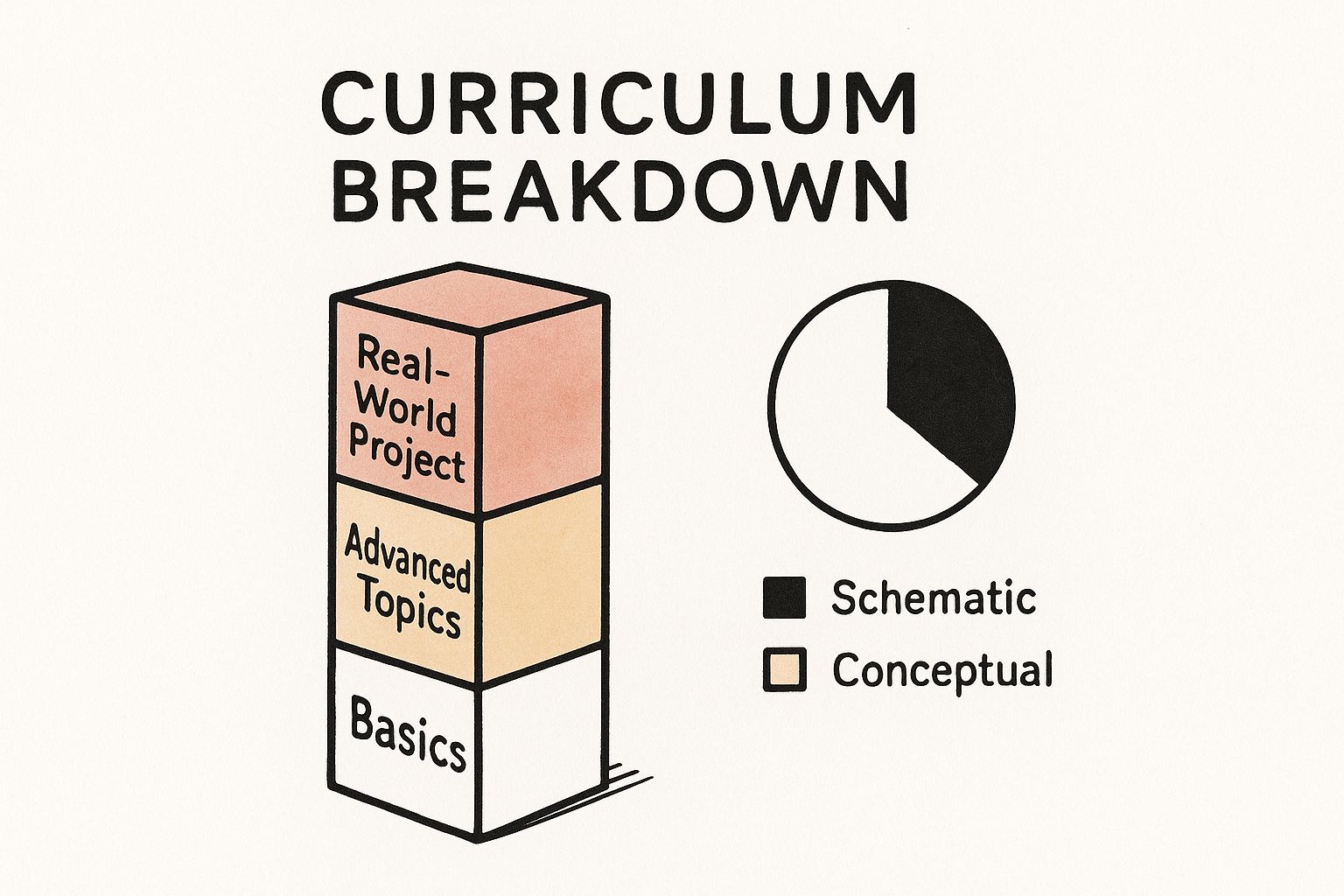
Think of it like building a house. You start with a solid foundation (the basics of Python), then you frame the walls (data structures), and finally, you put on a roof and add the finishing touches (building a full-fledged application).
Choosing Your Pace: Full-Time vs Part-Time
The other huge investment is your time. The right format for you boils down to your personal situation, how you learn best, and how quickly you want to switch careers. Neither path is better than the other—it’s all about what fits your life.
To help you figure it out, let’s compare the two head-to-head.
Comparing Bootcamp Formats: Full-Time vs Part-Time
| Aspect | Full-Time Immersive | Part-Time Flexible |
|---|---|---|
| Weekly Commitment | 40-60+ hours per week, basically a full-time job (and then some). | 10-20 hours per week, designed to fit around work and family, usually on evenings and weekends. |
| Total Duration | Super fast. Typically 12-16 weeks from start to finish. | A slower burn, usually lasting 6-12 months. |
| Ideal Candidate | Someone ready to make a clean break from their current job and dive in headfirst. | A working professional, parent, or anyone who needs to keep their day job while they learn. |
| Pros | The absolute fastest way to a new career. You live and breathe code, and the bonds you form with your cohort are intense. | You can keep your income, apply what you learn at your current job, and avoid total burnout. |
| Cons | You have to quit your job, which requires serious financial planning. The pace can be grueling. | It takes longer to graduate, and you need a ton of self-discipline to stay on track when life gets busy. |
Ultimately, this is a personal call. A full-time program is an all-out sprint to the finish line, while a part-time program is more of a marathon that you weave into your existing life. Take a hard look at your finances, your support system, and your own learning style to choose the path that will truly set you up for success.
Understanding Job Outcomes and Career Support
You’ve finished the final project and earned that certificate. Now what? The real reason you signed up for a python coding bootcamp wasn't just to learn to code—it was to land a great job in tech. This is where a bootcamp’s promises are put to the test, and the focus shifts from learning to earning.
Think of it like this: graduating from the bootcamp is like earning your pilot's license. You know how to fly the plane, but you've only ever done it in a controlled setting. Now you need a seasoned co-pilot to help you navigate the chaos of the real-world job market. That co-pilot is the bootcamp's career services team.
From Student to Employed Professional
Making that leap from graduate to a paid professional doesn't happen by accident. The best programs have a clear, structured process to guide you through the job hunt, which, frankly, can feel like a full-time job itself. The support you get should be hands-on and practical, all aimed at making you the candidate they can't ignore.
A top-notch career services department does a lot more than just send a few encouraging emails. They become your strategic partners.
- Portfolio and Resume Refinement: They'll help you tune up your resume to sail past the automated filters and truly showcase your new Python skills. Even more important, they'll make sure your project portfolio tells a compelling story about what you can build.
- LinkedIn Profile Optimization: In tech, your online presence is your first impression. Coaches will help you craft a professional brand on platforms like LinkedIn, making you visible to the right recruiters.
- Networking Strategy: They’ll plug you into their network of alumni and hiring partners through exclusive career fairs and networking events, opening doors that are typically hard to find on your own.
The best career support is proactive, not reactive. It shouldn't wait for you to ask for help; it should lay out a clear, step-by-step roadmap for your job search the day you graduate.
This kind of comprehensive support system is built to arm you with the confidence and tools needed to succeed in a competitive field.
Mastering the Technical Interview
For most new developers, the technical interview is the most daunting part of the process. It's a high-pressure situation where you’re expected to solve coding problems on the fly, usually on a whiteboard or a shared screen. A bootcamp's career services team will spend a huge amount of time preparing you for exactly this.
They run mock interviews that feel just like the real thing, giving you blunt feedback on your code and how you communicate your thought process—a skill that interviewers often care about more than the perfect answer. You’ll also practice behavioral questions so you can clearly explain why you’re switching to tech and how your old skills apply. For anyone aiming for specific certifications, solid prep is non-negotiable. It’s smart to look for additional resources, like guides on how to get the most from MeasureUp practice tests, to give yourself an extra edge.
Diverse Career Paths After Graduation
A Python coding bootcamp opens up a surprisingly wide variety of career paths. You’re not just training for a single job title. Python is so versatile that you can jump into several high-demand fields, all with fantastic earning potential.
Common Job Titles for Bootcamp Grads
| Job Title | Average Entry-Level Salary (US) | What They Do |
|---|---|---|
| Software Developer | $75,000 – $95,000 | Build and maintain web applications, APIs, and the backend systems that power them. |
| Data Analyst | $65,000 – $85,000 | Use Python libraries like Pandas to clean, analyze, and visualize data to uncover business insights. |
| QA Engineer | $70,000 – $90,000 | Write automated scripts to test software, hunt down bugs, and ensure the final product is flawless. |
| DevOps/Automation Engineer | $80,000 – $100,000 | Create scripts and tools that automate infrastructure and make the development process smoother for everyone. |
Keep in mind, these numbers are just the starting line. Your earning potential grows dramatically as you gain experience. The skills you get from a bootcamp are a springboard for a long and successful career, whether your goal is to become a senior engineer, a machine learning expert, or a team lead. This focus on real-world results is what makes a bootcamp such a powerful investment in your future.
How to Choose the Right Bootcamp for You

Choosing a Python coding bootcamp can feel overwhelming. You're faced with a dozen different paths, all promising to launch you into a new tech career. So, how do you cut through the noise and slick marketing to find a program that actually delivers? The trick is to think like an investigator, armed with the right questions and a healthy dose of skepticism.
This isn't just about picking a school; it's about finding a true partner for your career change. The right fit will match your learning style, professional goals, and financial reality. The wrong one can be a frustrating and expensive detour.
The demand for developers is exploding, and the bootcamp market is rushing to keep up. In fact, the market is projected to grow by almost USD 3.98 billion between 2025 and 2029. More options are great, but it also means you have to be a much smarter consumer. You can read the full research about this market expansion from Technavio to get a feel for the industry's direction.
Evaluate the Curriculum and Instructors
First things first: dig into what you’ll actually be learning every day. The curriculum needs to be modern and directly relevant to the jobs you're targeting. Look for in-demand technologies like Django or Flask for web development, or Pandas and Scikit-learn for data science. Does the syllabus line up with the skills listed in the job descriptions that catch your eye?
Just as important are the people at the front of the room. Who are the instructors? Don't just get dazzled by fancy degrees; look for real-world, in-the-trenches industry experience. The best teachers are often current or former software engineers who can share practical insights you’ll never find in a textbook.
A bootcamp's value isn't just in the information it provides, but in how that information is delivered. An experienced instructor who can explain complex topics with clarity and provide hands-on mentorship is worth their weight in gold.
Pay attention to the student-to-instructor ratio. A lower ratio means you'll get more personalized help when you inevitably get stuck on a tricky concept. The top-tier programs ensure their instructors and teaching assistants are readily available for one-on-one support.
Scrutinize Job Placement Statistics
This is where you need to put your detective hat on. Every bootcamp boasts about its high success rates, but these numbers can be notoriously misleading. It’s your job to get to the truth behind the marketing claims. Don't be shy about asking direct, specific questions.
Here are the non-negotiable questions you have to ask:
- "What are your independently audited job placement statistics?" The key phrase here is independently audited. This means a neutral third party has verified their numbers, making them far more credible.
- "What is the timeframe for that placement rate?" A 90% placement rate sounds amazing, but it means very little if it takes graduates a full year to land a role. Ask for the rates within three months and six months of graduation.
- "Does that statistic include only full-time, in-field jobs?" Some schools puff up their stats by including part-time gigs, temporary contract work, or even jobs that have nothing to do with tech. You need to know how many grads landed the kind of full-time developer job you're after.
A transparent bootcamp will have these answers ready and will be happy to share them. If an admissions advisor gets defensive or dodges the question, consider it a major red flag.
Connect with Past Graduates
Without a doubt, the best way to get an honest review of a program is to talk to the people who've actually completed it. Ask the admissions team to connect you with a few recent alumni. If they hesitate, you can usually find graduates yourself by searching for the bootcamp's name on LinkedIn.
Send a polite message and ask if they'd be willing to chat for 15 minutes. You’d be surprised how many people are happy to share their experience—good or bad.
Ask them about:
- The Instructor Quality: Were the teachers engaging, experienced, and available to help?
- The Career Support: Did the career services team provide real, effective help with resumes, interviews, and networking?
- The Overall Experience: Looking back, was it worth the time and money? What do they wish they knew beforehand?
Getting this inside perspective is priceless. It's the same principle as preparing for a tough technical exam; talking to people who've already passed is invaluable. For more on this, see our guide on how do I get Microsoft Certified. Hearing directly from alumni helps you see past the sales pitch and understand what you can truly expect, allowing you to make a decision you'll be confident in.
Still on the Fence? Let's Tackle Those Lingering Bootcamp Questions
Taking the plunge into a Python coding bootcamp is a big decision, and it’s totally normal to have some last-minute questions. This is where we'll clear up the common worries that might be holding you back, so you can move forward with confidence.
Let's get into the practical, nitty-gritty concerns—from what you need to know beforehand to what the experience really feels like.
Do I Need to Be a Coder Already?
This is the big one, and the short answer is no. But there’s a small asterisk. The vast majority of bootcamps are built from the ground up for career-changers and absolute beginners. They don't expect you to walk in with a tech background.
The catch? The pace is blistering. To make sure you don't get left behind on day one, most programs have some required pre-work. This usually covers the bare-bones basics, like what a variable is or how a for loop works. It’s not a test to screen you out; it's a way to make sure everyone starts on the same page.
Think of the pre-work like learning your scales before joining a band. You don't have to be a rockstar, but knowing the fundamentals lets you jump right into making music with everyone else. A few weeks spent with some free tutorials will make the actual bootcamp experience a whole lot smoother.
Can I Really Get a Tech Job Without a Computer Science Degree?
Yes, without a doubt. In fact, that’s the entire point of a bootcamp. The tech industry has made a major shift, prioritizing what you can do over what degree you have. What hiring managers really care about is simple: can you solve their problems with code?
Your bootcamp portfolio is your proof. The projects you build—the web scrapers, the data dashboards, the full-stack applications—are tangible evidence of your skills. When an employer can click a link and see a working app you built from scratch, that often carries more weight than a piece of paper. Your certificate, a polished portfolio, and a solid performance in the technical interview are the new credentials for landing a great developer job.
What’s the Toughest Part of a Bootcamp?
Get ready for the firehose. Almost everyone agrees the hardest part is the relentless pace. A bootcamp crams a mind-boggling amount of complex, technical information into a few short months. It’s a full-on sprint that demands all of your attention and can be mentally draining.
You will almost certainly have moments of “imposter syndrome”—that nagging feeling that you’re not cut out for this and everyone else is smarter than you. It happens to the best of us. The secret to getting through it is to trust the process, stay organized, and lean on your instructors and fellow students. That intense pressure is exactly what forges you into a capable developer so quickly.
Why Not Just Teach Myself Python Online?
Going the self-taught route works for some, but a Python coding bootcamp gives you three massive advantages that are tough to find on your own: structure, support, and speed.
- Structure: A well-designed curriculum is your roadmap. It saves you from "tutorial hell"—that endless cycle of bouncing between random YouTube videos and blog posts without ever connecting the dots. A bootcamp teaches you the right things in the right order.
- Support: When you’re stuck on a bug at 2 AM (and you will be), having an instructor or classmate to turn to is a lifesaver. This human element helps you push through the frustrating roadblocks that cause so many self-learners to give up.
- Speed: This is the bottom line. The combination of an intensive schedule, project-based learning, and career services dramatically shrinks the timeline between writing your first line of code and landing your first developer job.
Ready to take the next step in your cloud career? At AZ-204 Fast, we provide the specialized tools you need to master the Microsoft Azure Developer certification exam. Our platform uses proven learning techniques like spaced repetition flashcards and dynamic practice tests to ensure you're not just memorizing, but truly understanding the material. Conquer the AZ-204 exam with confidence by visiting us at AZ-204 Fast.
Leave a Reply