
So, what exactly is a cloud engineer bootcamp? Think of it as an intensive, career-focused training program designed to give you the practical skills needed to build, manage, and scale cloud infrastructure. For many people, it’s the most direct route into a high-demand tech career, compressing what could take years to learn into just a few focused months. The real value is in its hands-on approach, which skips the abstract theory and gets right into real-world applications.
Decoding the Value of a Cloud Engineer Bootcamp
Is a cloud engineer bootcamp actually worth the time and money? For a growing number of career-changers and aspiring tech professionals, the answer is a clear "yes." These programs aren't just courses; they're career launchpads, built specifically to meet the urgent needs of today's job market.
Here's a good way to look at it: a traditional university degree gives you a broad, theoretical map of the entire country. A bootcamp, on the other hand, is like a GPS giving you the most direct, turn-by-turn route to your destination—landing a job as a cloud engineer. It cuts out the scenic detours and focuses exclusively on the critical skills needed to get you there fast.
This fast-tracked model works so well because the cloud computing industry is absolutely booming. Businesses in every sector, from finance to healthcare, are moving their operations to the cloud to become more flexible and efficient. This mass migration has created a massive skills gap, with far more open cloud engineer roles than qualified people to fill them.
A cloud engineer bootcamp bridges this gap by creating an immersive learning environment that mirrors the real-world challenges you'll face on the job. It’s less about memorizing definitions and more about deploying applications and solving actual infrastructure problems.
The Driving Force Behind Bootcamp Demand
The incredible value of a cloud engineer bootcamp is tied directly to the industry's explosive growth. The global cloud computing market is expanding at a staggering pace. In 2024, the market soared past $752 billion and is projected to nearly triple to $2.39 trillion by 2030—that's an annual growth rate of 20.4%. This economic engine is fueled by the relentless demand for cloud expertise, especially for professionals skilled in major platforms like Amazon Web Services (AWS) and Microsoft Azure. You can dig deeper into these industry growth projections in DigitalDefynd's analysis.
This rapid expansion means one thing for graduates: opportunity. Companies are desperately looking for candidates who have practical, hands-on skills, not just a degree on their resume.
To help put the benefits into perspective, here’s a quick breakdown of what these programs offer.
Cloud Engineer Bootcamp Value at a Glance
| Key Benefit | What It Means for You |
|---|---|
| Accelerated Learning Path | Get job-ready in months, not years. |
| Hands-On, Practical Skills | Build a portfolio of real-world projects that prove your abilities. |
| High Return on Investment (ROI) | Invest in skills that lead directly to high-paying, in-demand jobs. |
| Industry-Aligned Curriculum | Learn the exact tools and technologies employers are using right now. |
| Career Support Services | Get help with resume building, interview prep, and job placement. |
Ultimately, a bootcamp gives you a clear and efficient pathway into a thriving industry, equipping you with the skills that companies are hiring for today.
Who Benefits Most from This Model?
While anyone with the right drive can succeed, the bootcamp format is a particularly good fit for a few key groups. See if you recognize yourself in one of these descriptions.
- Career Changers: You're coming from a non-tech field—maybe teaching, marketing, or retail—and want a direct path into a stable and lucrative tech career without going back for a four-year degree.
- IT Professionals Upskilling: You're already a system admin, network engineer, or developer, but you see the writing on the wall. The industry is moving to the cloud, and you need to learn these new skills to stay relevant and move up.
- Recent Graduates: You have a degree in a related field, but your education was mostly theoretical. You need the specific, hands-on cloud skills that will make your resume stand out to hiring managers.
In the end, the true worth of a cloud engineer bootcamp is measured by its ability to deliver a real return on your investment. By offering a condensed, practical, and career-focused education, it gives you a powerful alternative to traditional learning, aligning your skills directly with the urgent needs of a multi-trillion-dollar industry.
What You'll Actually Learn in a Bootcamp
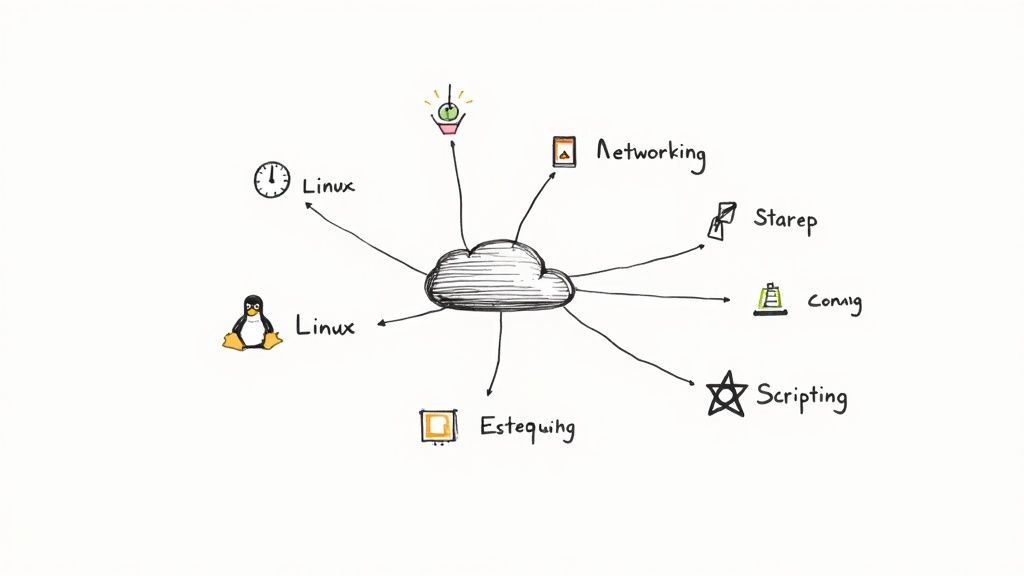
So, you're thinking about a cloud engineer bootcamp. It's a big step, and it’s natural to wonder what exactly happens inside. What skills will you really walk away with? Let's break down the typical curriculum, piece by piece, to show you how these programs build your expertise from the ground up.
Think of it like building a house. You can't put up the walls and roof without a rock-solid foundation. The first few weeks of any good bootcamp are all about pouring that concrete.
This means starting with the absolute fundamentals of cloud computing. You won't just memorize definitions; you'll get a real feel for the core service models that run everything from your favorite streaming service to critical business software.
- Infrastructure as a Service (IaaS): This is the ground floor. You'll learn to spin up virtual servers (think Amazon EC2 or Azure VMs) and set up networking. It's like being handed the raw building materials.
- Platform as a Service (PaaS): Building on IaaS, this layer gives developers pre-built environments to deploy their apps without having to manage the underlying hardware.
- Software as a Service (SaaS): This is the finished product, the apps we use every day like Google Workspace or Salesforce, delivered right over the internet.
Mastering the Core Cloud Platforms
Once you've got the concepts down, you'll get your hands dirty with the major cloud providers. This is where the real fun begins. Most programs focus on at least one of the "big three"—Amazon Web Services (AWS), Microsoft Azure, or Google Cloud—because that’s where the jobs are.
A top-tier cloud engineer bootcamp makes sure you’re not just familiar with key services but genuinely proficient. You’ll spend a ton of time working directly in the cloud console, learning by doing.
For instance, you won't just read about virtual machines. You'll launch them, configure their security settings, and figure out how to scale them up and down yourself. This hands-on philosophy applies to every core area:
- Compute Services: Getting comfortable deploying and managing virtual workhorses like AWS EC2 and Azure Virtual Machines.
- Storage Solutions: Learning to work with massive-scale object storage like AWS S3 or Azure Blob Storage for everything from website assets to big data.
- Database Management: Spinning up and managing cloud databases, both relational (like Amazon RDS) and NoSQL.
The real goal isn't just to teach you what a service is, but how to use it to solve an actual business problem. You'll learn to think like an engineer, choosing the right tool for the job by weighing cost, performance, and security.
Building Modern Infrastructure with Automation
In today's world, just clicking around a web console isn't enough. Modern cloud engineering is all about speed, consistency, and automation. The next stage of your training will introduce the tools that separate the hobbyists from the pros.
This is where you learn to treat your infrastructure like software by using Infrastructure as Code (IaC). It's a non-negotiable skill for any serious cloud role. You’ll use tools like Terraform or AWS CloudFormation to write scripts that can build out entire, complex environments in minutes—flawlessly and repeatedly.
From there, you’ll dive into CI/CD (Continuous Integration/Continuous Deployment). This is the engine that powers modern software delivery. You'll learn to build automated pipelines that grab new code from a developer, run tests on it, and push it live to the cloud with almost no human intervention. To get these jobs done, you might use scripting tools like PowerShell. If you’re in the Azure ecosystem, our guide on the Azure PowerShell module is a great resource for getting up to speed.
Let’s see how it all comes together in a typical final project, like deploying a scalable web app.
- Define Infrastructure: First, you’d write a Terraform script to define your network, servers, and database as code.
- Automate Deployment: Next, you’d build a CI/CD pipeline in a tool like Jenkins or GitHub Actions.
- Push and Deploy: When a developer pushes new code, the pipeline you built automatically tests it and rolls it out to the infrastructure you defined in step one.
A single project like this forces you to connect the dots between networking, compute, databases, IaC, and automation. It's the ultimate proof to an employer that you can do the job.
Real Career Outcomes After Graduation

So, you've powered through weeks of intense learning, wrestled with hands-on labs, and conquered a capstone project. What’s next? The real test of any bootcamp is the career it launches. This is where all that hard work pays off and turns into real-world opportunities in a booming industry.
Finishing a good bootcamp is like getting your pilot’s license for the cloud. You don't just have a piece of paper; you have the practical, hands-on skills to fly complex digital infrastructures from your very first day on the job. That kind of job-readiness is a huge deal for hiring managers and opens a lot of doors.
The skills you walk away with—whether it's managing services in AWS or Azure, or automating deployments with tools like Terraform—are a direct match for what companies are looking for. You won’t just know the theory; you'll have a portfolio of real projects that proves you can actually do the work.
Common Job Titles for Graduates
With your new toolkit of skills, you’ll be ready to apply for several key entry-level and junior roles in the cloud world. Think of these as the first rung on a long and rewarding career ladder, each with its own unique focus.
Here are a few of the most common jobs that bootcamp grads land:
- Cloud Engineer: This is the most direct path. You'll be designing, building, and maintaining an organization's cloud infrastructure.
- DevOps Engineer: In this role, you’ll focus on bridging the gap between developers and IT operations, building automated pipelines, and making deployments smoother and faster.
- Cloud Support Associate: You'll be on the front lines, helping customers troubleshoot and solve technical problems with their cloud services.
Each of these positions is a fantastic launchpad. From here, you can deepen your expertise and eventually move into specialized areas like cloud security, architecture, or data engineering.
The real edge for bootcamp grads is practical experience. A traditional degree might be heavy on theory, but your bootcamp portfolio shows an employer you've already built, deployed, and managed cloud resources. That makes you a much less risky—and more valuable—hire.
A Realistic Look at Salary Expectations
One of the biggest draws to a cloud engineering career is the earning potential, even right out of the gate. The demand for skilled cloud pros is so high that companies are willing to pay competitively for fresh talent.
For their first job, many bootcamp graduates can expect a starting salary in the $70,000 to $80,000 range. That number reflects the immediate value you bring to the table. This is just a starting point, too.
The cloud industry is known for fast career growth, and your salary will grow with it. After a few years of experience, and maybe another certification under your belt, your earning potential can jump significantly. For instance, getting a respected credential can really move the needle, and you can learn more about how to get Microsoft certified in our guide.
Ultimately, a cloud engineer bootcamp does more than just give you a certificate. It acts as a direct on-ramp to a stable, well-paying, and future-proof career. By giving you the specific, hands-on skills that employers are desperate for right now, it sets you up for immediate success and a long, rewarding journey in the ever-growing world of cloud tech.
How to Choose the Right Bootcamp Program
Picking the right cloud engineer bootcamp can feel like a huge decision—because it is. This is the foundation for your new career, and you want to build it on solid ground. Not every program is built the same, and what works wonders for one person might be a total mismatch for another. The real trick is to look past the shiny marketing promises and dig into the details that actually matter for your learning and, ultimately, your job prospects.
Think of it like choosing a personal trainer. You wouldn't just go with the person who has the slickest Instagram page. You’d want to know their training philosophy, see their clients' results, and make sure their approach fits your specific fitness goals. It's the exact same process here. You need to find a bootcamp that clicks with your learning style, career goals, and budget.
Assess the Curriculum Depth and Focus
First things first: what are you actually going to learn? The curriculum is the heart and soul of any bootcamp. Some programs go deep on a single cloud platform, like Amazon Web Services (AWS), aiming to make you an expert in the market leader. Others take a multi-cloud approach, giving you a solid foundation in AWS, Microsoft Azure, and Google Cloud Platform (GCP).
Is one better than the other? Not necessarily. A deep dive into AWS can make you a specialist, which is exactly what some companies want. But having multi-cloud skills makes you more versatile and can open up a wider range of job opportunities. It really comes down to the kind of roles you see yourself in.
This chart gives you a quick look at where the major cloud providers stand in the market.
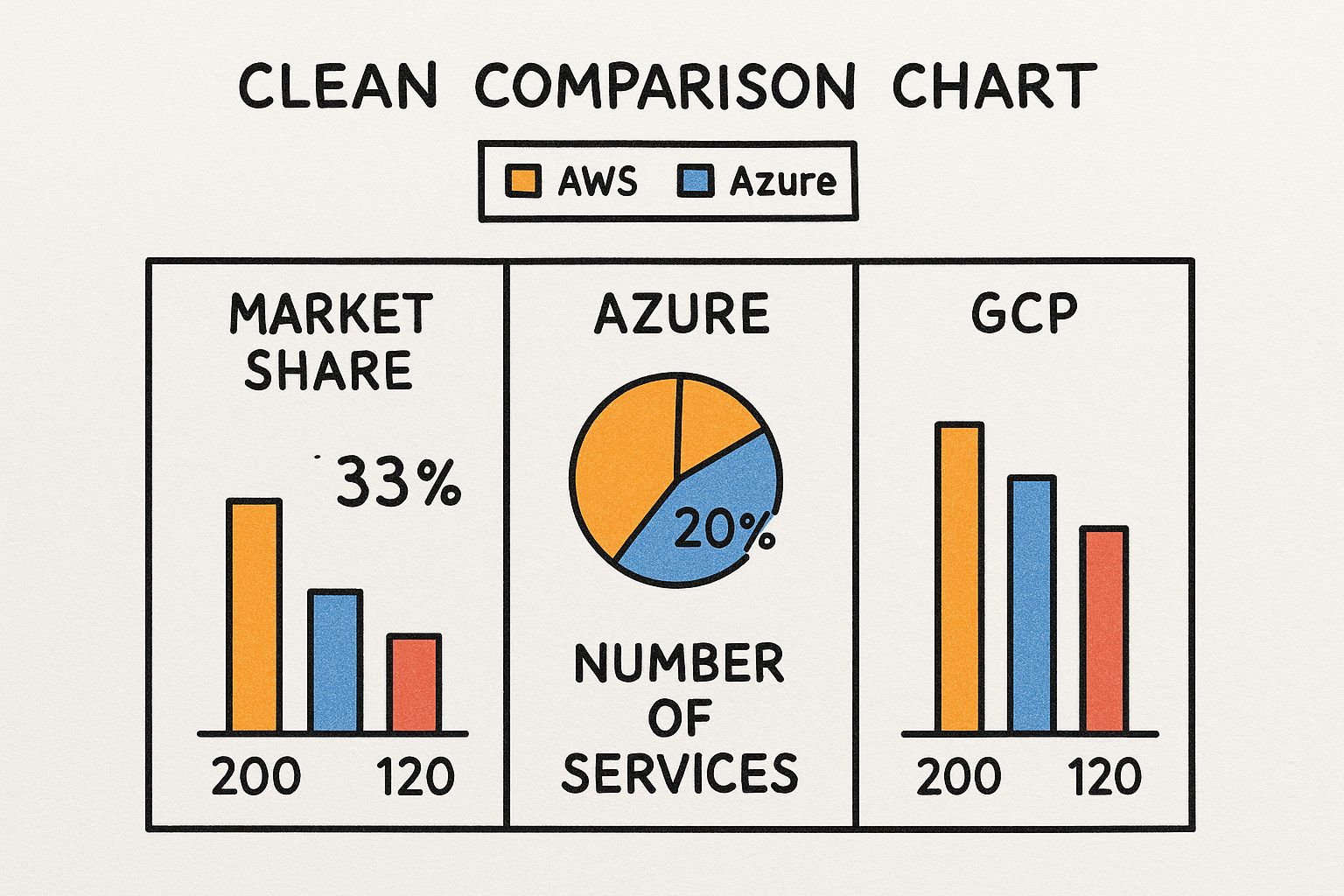
As you can see, AWS is the clear leader, but Azure and GCP hold significant chunks of the market. This is why having skills across multiple platforms is such a valuable asset for any cloud engineer.
Beyond just the platforms, you need to make sure the curriculum covers the tools and concepts that companies are actually using today. Look for these key areas:
- Infrastructure as Code (IaC): Is there serious hands-on training with tools like Terraform or AWS CloudFormation?
- CI/CD and Automation: Will you get your hands dirty building automated deployment pipelines with Jenkins or GitHub Actions?
- Containers and Orchestration: How much time is dedicated to the essentials: Docker and Kubernetes?
- Security Best Practices: Is security treated as an afterthought, or is it woven into every module?
These are the skills that hiring managers actively look for on a resume. They’re what separate a junior-level candidate from someone who can hit the ground running.
Evaluate Hands-On Projects and Career Support
Knowing the theory is great, but companies hire people who can build things. The best bootcamps are structured around practical, hands-on projects that you can proudly feature in your portfolio. You want a program that culminates in a capstone project—something where you build a complex, real-world cloud solution from scratch.
For example, many top programs are designed to be intensive, multi-month deep dives. The California Institute of Technology runs a 9-month Cloud Computing Bootcamp that immerses students in both AWS and Azure. A huge part of their curriculum is over 40 hands-on projects and that all-important final capstone, which ensures every graduate has real, provable experience to show off. You can see more programs with this hands-on approach by looking through various cloud computing bootcamp listings.
Just as important is what happens after you graduate. A bootcamp's job isn't done the moment you finish the last lesson.
The best programs act as true career partners. They offer dedicated support to help you navigate the job market, including resume workshops, mock technical interviews, and direct introductions to their network of hiring partners.
Don't be shy about asking tough questions. What's their placement rate within six months of graduation? What kind of companies hire their grads? A strong career services team can be the difference-maker in landing your first cloud role quickly. For instance, knowing how to deploy an application using a platform-as-a-service offering is a practical skill hiring managers love to see. We cover this in our guide explaining what Azure App Service is and why it's a key part of a cloud engineer's toolkit.
Compare Program Intensity and Total Cost
Finally, let's talk about the practical side of things: time and money. Bootcamps come in all shapes and sizes. Some are full-time, immersive programs that demand your complete attention for several months. Others are part-time and flexible, designed for people who need to keep their day jobs. Be honest with yourself about what you can realistically commit to. Burning out halfway through won't do you any good.
Cost is obviously a huge factor, too. A quality bootcamp is a serious investment, but you need to find one that makes financial sense for you. Look past the sticker price to understand the total cost, which might include extra fees for books or certification exam vouchers.
Some providers offer financing plans, scholarships, or even Income Share Agreements (ISAs), where you pay back a percentage of your salary only after you've landed a job. A higher price tag doesn't automatically equal a better program, so be sure to weigh the cost against the curriculum, project quality, and career support to figure out its true value.
Top Cloud Engineer Bootcamp Comparison
To help you get started, we've put together a table comparing some of the top bootcamps out there. This isn't an exhaustive list, but it gives you a side-by-side look at what different programs offer, so you can start to see what might be the best fit for you.
| Program Name | Focus (AWS/Azure/Multi-Cloud) | Duration | Format (Online/Hybrid) | Key Feature |
|---|---|---|---|---|
| Springboard | Multi-Cloud | 9 months | Online, Self-Paced | 1:1 mentorship and a job guarantee |
| Clarusway | AWS & Azure | 7 months | Online, Live Instruction | Strong focus on DevOps and hands-on labs |
| Simplilearn | Multi-Cloud | 9 months | Online, Blended | Partnership with Caltech CTME |
| KnowledgeHut | AWS & Azure | 6 months | Online, Live Instruction | Capstone project and real-world simulations |
| Thinkful | Multi-Cloud | 5 months (full-time) | Online, Live Instruction | Immersive, full-time format with ISA options |
Ultimately, the best bootcamp is the one that aligns with your specific needs. Use this table as a starting point, do your own research, and don't hesitate to reach out to admissions teams with your questions. Making an informed choice now will pay off massively down the road.
Preparing for Success Before and During Your Bootcamp
Getting into a cloud engineer bootcamp is a huge step, but the real work—and the real opportunity—starts long before your first class. The students who truly crush it are the ones who treat the bootcamp not as a starting line, but as a launchpad.
Think of it like training for a marathon. You wouldn't just roll out of bed and show up on race day, right? You’d spend weeks building a solid base of fitness. A bootcamp is a similar kind of endurance test for your brain, and a little prep work makes all the difference.
Building Your Foundation Before Day One
If you walk in with a handle on the core concepts, you can spend your time and energy wrestling with the complex cloud topics, not struggling with the basics. This isn't about becoming an expert overnight; it's just about getting familiar with the language and tools of the trade so you can hit the ground running.
Your pre-bootcamp prep should zero in on three key areas. Getting comfortable here will give you a massive leg up.
- Command-Line Basics: The command-line interface (CLI) is where a cloud engineer lives. Get comfortable navigating folders, creating directories, and moving files around with basic commands like
ls,cd, andmkdir. - Networking Fundamentals: No need for a network engineering degree, but understanding concepts like IP addresses, DNS, and the difference between TCP and UDP will make the cloud networking modules click into place so much faster.
- A Taste of Scripting: Cloud work is all about automation. Picking up the fundamentals of a scripting language like Python is a game-changer. Just focus on the basics—variables, loops, and simple functions—to get a feel for the logic.
By dedicating even a few weeks to these topics, you’re not just learning—you’re building momentum. This preparation ensures you can absorb advanced material more quickly and get more value out of every single lesson.
Strategies for Thriving During the Bootcamp
Once the program starts, the pace is intense. Success shifts from pre-study to smart, effective learning. It's incredibly easy to get swamped by the firehose of information, so having a strategy is key to not just surviving, but actually thriving.
The goal is to manage your energy and focus your efforts on what really moves the needle: deep, hands-on understanding.
Maximize Your Learning Efficiency:
- Embrace Active Recall: Don't just sit back and watch lectures. Constantly test yourself. After a lesson on AWS S3, try to explain its purpose and features out loud without looking at your notes. Forcing your brain to retrieve information is how you build strong, lasting memory.
- Treat Labs as Gospel: The hands-on labs are where the magic happens. This is your chance to break things, fix them, and figure out how cloud services really work. This practical work should be your top priority.
- Network Relentlessly: Look around. Your classmates and instructors are your first professional network in the cloud world. Jump on projects together, ask tons of questions, and build real relationships. These are the people who will have your back—and maybe even a job referral—down the line.
Leveraging Career Services and Building Your Portfolio
The final stretch is all about turning your new skills into a job offer. Your bootcamp's career services team is a powerful ally, but they're your partners, not your personal recruiters. You have to be proactive.
Connect with them early. They’ll help you reframe your resume to showcase your cloud projects and skills. They also run mock technical interviews, which are pure gold for practicing how to talk through your problem-solving process under pressure.
Ultimately, your portfolio is your proof. The capstone project is the main event, but don't ignore the smaller labs and projects you complete along the way. Document everything on a platform like GitHub, writing clear descriptions of what you built and the problems you solved. This becomes a tangible showcase that tells hiring managers you can actually do the work, making you a much stronger candidate in a crowded field.
Got Questions About Cloud Engineer Bootcamps?
Deciding to jump into a cloud engineer bootcamp is a huge step. It’s a big investment—of your time, your money, and your focus—so it's completely normal to have a ton of questions before you commit. We've been there, and we've heard it all from aspiring students.
Let's cut through the noise and tackle the big questions head-on. Think of this as the straightforward, no-fluff FAQ you've been looking for.
"Do I Really Need a Computer Science Degree?"
This is easily the number one question we hear, especially from people looking to switch careers. And the answer is a resounding no, you do not need a computer science degree.
Sure, a technical background can give you a bit of a head start, but it’s absolutely not a dealbreaker. The best bootcamps are built for motivated people from all walks of life—we're talking former teachers, project managers, and even baristas who decided they wanted to build a future in tech.
What really matters to admissions teams and, more importantly, to future employers, is your drive to learn and your ability to solve problems. In the tech world today, what you can do matters far more than what your diploma says.
Your portfolio full of hands-on projects, your new cloud certifications, and your solid grasp of core concepts will open more doors than a degree you earned years ago. The whole point of a bootcamp is to prove that practical skill is the ultimate qualification.
Plenty of successful cloud engineers started out in fields that had nothing to do with tech. Their stories are proof that passion and grit are the only true prerequisites.
"How Much Hands-On Experience Will I Actually Get?"
This question gets right to the heart of why bootcamps work. Unlike a traditional college course that might be heavy on theory, a good cloud bootcamp is all about one thing: learning by doing. You'll spend the vast majority of your time with your fingers on the keyboard, working inside real cloud platforms like AWS, Azure, and Google Cloud.
The curriculum is designed to get you from concept to practice in minutes, not weeks. You won’t just sit through a lecture about virtual machines; you’ll be in the cloud console deploying, configuring, and even breaking them yourself. It's about building that muscle memory and practical intuition that you can't get from a textbook.
This hands-on work usually follows a clear path, with projects getting more complex over time:
- Foundational Labs: Think of these as small, focused drills. You'll learn a single service by doing a single task, like setting up an S3 bucket or launching an EC2 instance.
- Mini-Projects: Here, you'll start connecting the dots by combining a few services to solve a simple problem, like hosting a basic website using cloud storage and a content delivery network (CDN).
- The Capstone Project: This is the big one—your final showcase. You’ll take everything you’ve learned and build a complex cloud solution from the ground up. This could be a scalable web app with a database, automated deployment pipelines, and security monitoring.
This project-first approach means you don't just graduate with knowledge. You graduate with a portfolio of real work that proves to companies you can step in and contribute from day one.
"What Happens If I Don’t Land a Job Right Away?"
It's completely normal to worry about the job hunt. While many grads find roles quickly, the market is competitive, and for some, the search takes a bit longer. Any bootcamp worth its salt knows this and builds a strong support system to see you through it.
Your relationship with the program shouldn't end the day you graduate. Their career services team should become your partner, your coach, and your cheering section during the job search.
This support is your safety net and your strategic advantage. It typically includes:
- Career Coaching: One-on-one sessions to help you define your goals, build a smart job search strategy, and keep your motivation high when things get tough.
- Resume and Portfolio Reviews: Getting an expert eye on your application materials is critical. They'll help you frame your new cloud skills and projects in a way that gets a hiring manager's attention.
- Interview Prep: This is huge. You’ll run through mock technical and behavioral interviews to build confidence and learn how to talk about your problem-solving process under pressure.
- The Alumni Network: You'll get access to a whole community of people who have been exactly where you are. They're an amazing source of advice, support, and often, job referrals.
If you don't get hired immediately, the key is to stay in the game. Keep building small projects, study for another certification, and work that alumni network. A good program’s career team will stick with you, helping you tweak your approach until you land that first role. It's a marathon, not a sprint, and they provide the coaching you need to cross the finish line.
Ready to conquer the cloud and earn your Microsoft Azure certification? At AZ-204 Fast, we provide the focused, research-backed study tools you need to pass the exam efficiently. Master the material in weeks, not months, with our interactive flashcards, practice exams, and progress analytics. Start your journey with AZ-204 Fast today!
Leave a Reply