
The Microsoft Azure Developer certification, officially known as the AZ-204: Developing Solutions for Microsoft Azure, is a must-have credential for any professional serious about building and managing applications in the cloud. It's the industry's stamp of approval, confirming your skills in creating powerful, scalable, and secure solutions using Microsoft Azure.
What Is the Azure Developer Certification?
At its heart, the Azure Developer certification is much more than a badge. Think of it as a professional benchmark. It tells the world that you don't just know about Azure; you know how to get your hands dirty, designing, building, testing, and maintaining real-world applications on the platform.
This isn't an entry-level exam. It’s geared toward developers who already have one to two years of solid, professional development experience under their belt, along with a working knowledge of Azure. Passing the AZ-204 signals to employers that you can hit the ground running and immediately contribute to their cloud projects.
To give you a quick overview, here are the core details of the certification in a nutshell.
AZ-204 Certification at a Glance
| Attribute | Details |
|---|---|
| Official Title | Microsoft Certified: Azure Developer Associate |
| Exam Code | AZ-204 |
| Target Audience | Cloud developers with 1-2 years of experience |
| Key Skills Tested | Azure compute, storage, security, monitoring, and troubleshooting |
| Prerequisites | Professional development experience and familiarity with Azure |
| Renewal | Annually, via a free online assessment |
This table captures the essentials, but the real value comes from understanding who truly benefits from this certification and why.
Who Should Pursue This Certification?
If you're a developer aiming to pivot or specialize in cloud technologies, the AZ-204 is a natural and strategic next step. It’s the perfect bridge between traditional software development and the specialized world of cloud-native engineering.
It's especially valuable if your daily work involves (or you want it to involve):
- Building cloud applications: Creating and deploying web apps, APIs, and microservices on Azure.
- Automating everything: Integrating your apps into CI/CD pipelines and managing infrastructure as code.
- Working with data: Connecting applications to robust Azure storage services like Cosmos DB and Blob Storage.
- Implementing security: Locking down your applications with proper identity management and secure configurations.
This certification has quickly become a cornerstone for cloud professionals. It consistently ranks as one of the top Azure certifications because it validates the exact skills companies need to build and maintain their cloud presence.
A Benchmark for Cloud Competence
Earning the AZ-204 sets a clear standard for your professional capabilities. It’s tangible proof of your commitment to mastering the tools and best practices that define modern cloud development. If you're curious about the general path to getting certified, you can explore our guide on how to get Microsoft certified.

As you can see from the official page, the focus is squarely on developers who are actively involved in the entire application lifecycle. This practical validation is precisely what makes the Microsoft Azure Developer certification a powerful career move, opening up opportunities for more complex projects and senior-level roles. It’s a direct investment in your professional growth.
How the AZ-204 Certification Boosts Your Career
Earning the Microsoft Azure Developer certification does a lot more than just tack another line onto your resume. Think of it as a genuine career accelerator—a clear signal to employers that your cloud development skills are not just claimed, but proven, relevant, and ready for the real world.
Without a formal credential, your expertise is part of your professional story. With the AZ-204, that expertise becomes the headline. It immediately tells hiring managers you know how to design, build, and manage applications on one of the world's most dominant cloud platforms.
Unlocking New Career Opportunities
Simply put, the AZ-204 certification is a key that opens doors. It helps you stand out in a crowded job market and makes you a much more attractive candidate for specialized, higher-impact roles.
Many developers I've spoken with find this certification is the very thing that helps them transition into positions like:
- Cloud Developer: A role focused squarely on building and deploying applications designed for the cloud from day one.
- DevOps Engineer: A position that blends development with operations, where you'll be automating infrastructure and deployment pipelines on Azure.
- Senior Software Engineer: A leadership role where you guide architectural decisions for complex cloud-based systems.
This isn't just about a fancier title. It’s about taking on more interesting technical puzzles, having more influence over projects, and shaping how applications are built from the ground up.
The AZ-204 acts as a powerful validator. It transforms your claimed skills into proven competencies. It’s the difference between saying you can build on Azure and proving you've mastered the official best practices.
Meeting Surging Industry Demand
The need for skilled Azure developers is exploding. This isn't just hype; it's a direct result of a massive enterprise shift to the cloud across every industry you can think of—finance, healthcare, retail, you name it. This migration creates a constant demand for developers who can build, maintain, and innovate on the platform.
In fact, the demand for Azure-certified professionals has seen staggering growth, with some reports showing year-over-year increases of around 200%. This trend fits perfectly with broader labor market forecasts, which predict that computing and IT jobs will grow much faster than the average for all other occupations through 2033. If you want to dig into the data, you can review the Azure certification path insights to see the trends for yourself.
Future-Proofing Your Skill Set
Ultimately, earning your Microsoft Azure Developer certification is an investment in your long-term career resilience. Cloud computing isn't a passing fad; it's the bedrock of modern software development. By mastering Azure, you're aligning your skills with where the entire industry is headed.
The certification journey also forces you to learn parts of the Azure ecosystem you might not touch in your daily job. You’ll gain a much deeper understanding of everything from advanced security protocols and monitoring strategies to the nuances of different data storage options. This broader knowledge makes you a more versatile and adaptable developer, ready for whatever new challenges and technologies come next. It’s about making sure your skills stay valuable for years to come.
Breaking Down the AZ-204 Exam Objectives

To really get ready for the Microsoft Azure Developer certification, you have to stop thinking like you're just studying for a test. You need to think like an architect. The official list of exam objectives from Microsoft can feel a bit dry and disconnected from the real world of a developer. So, let’s look at it another way.
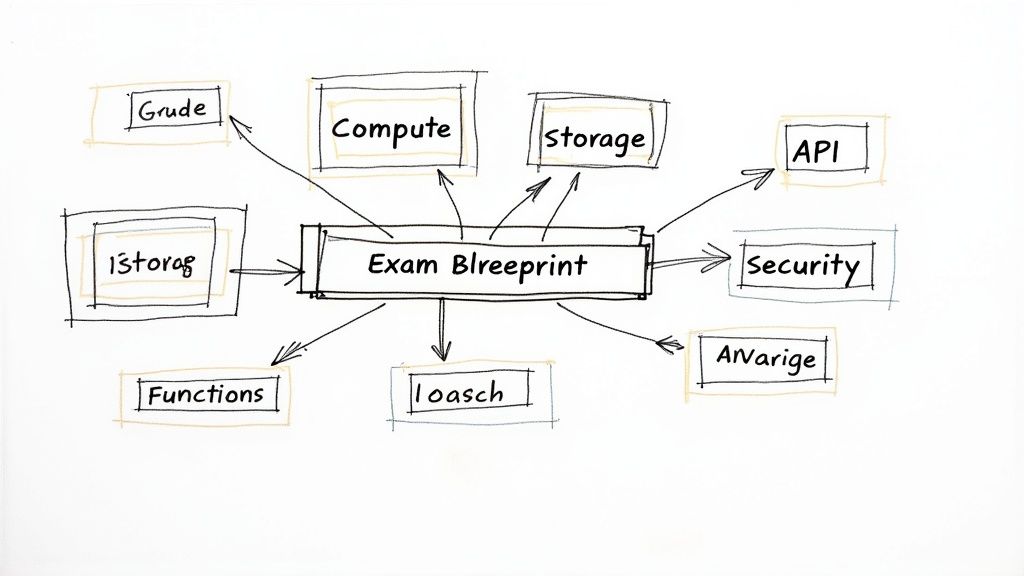
Instead of seeing a checklist, view the AZ-204 blueprint as the master plan for building a modern, resilient cloud application. Each section represents a critical piece of that puzzle. Getting a handle on them isn't about memorizing service names; it's about knowing which tool to grab for which job and, more importantly, why it's the right choice. This mindset turns study time into practical, on-the-job expertise.
Develop Azure Compute Solutions (25-30%)
This is the big one—the foundation of everything else. This part of the exam is all about one simple question: where does your code actually live and run in the cloud? Think of it like choosing the right engine for a vehicle. A souped-up sports car, a heavy-duty delivery truck, and a family minivan all need engines, but they each require a very different kind to do their job well.
Your application's code is no different. The AZ-204 expects you to know which Azure "engine"—or compute service—is the best fit for any given situation.
-
Azure App Service: This is your bread and butter for hosting web apps and APIs. If you’re building a customer-facing e-commerce site, for instance, App Service is perfect. It manages all the messy infrastructure details—the servers, the load balancing, and the scaling—so you can just focus on your code. You’ll need to know how to deploy your work, hook up custom domains, and configure auto-scaling rules to handle traffic spikes during a Black Friday sale.
-
Azure Functions: This is where you turn for event-driven, serverless solutions. Imagine you need to generate an image thumbnail every single time a user uploads a new photo. Instead of paying for a server to sit around 24/7 just waiting for that to happen, an Azure Function can spring to life, run its code, and shut down in a flash. It's incredibly efficient. For the exam, you'll need to understand triggers, bindings, and the art of writing small, focused functions.
-
Container-based Solutions: This bucket includes services like Azure Container Apps and Azure Kubernetes Service (AKS). If your application is designed as a collection of microservices, containers are the natural fit for packaging and deploying them. You'll be expected to know the workflow: create a container image, push it to a registry like Azure Container Registry, and then run it on one of Azure’s container platforms.
Develop for Azure Storage (15-20%)
Every app needs to store data, but "data" is a slippery term. It can mean a million different things. This domain tests your ability to pick and implement the right storage for the right kind of data. It’s the difference between a filing cabinet for your documents, a steel safe for your valuables, and a giant warehouse for your bulk inventory.
The key to mastering this section is understanding that not all data is created equal. The way you store user profile information is fundamentally different from how you store massive video files or temporary application cache.
Here’s how that plays out in the real world:
-
Azure Blob Storage: This is your go-to for unstructured data—think images, videos, documents, and log files. For example, if your app lets users upload a profile picture, you'd use the Azure SDK in your code to securely upload that image to a Blob Storage container.
-
Azure Cosmos DB: This is a powerhouse: a multi-model, globally distributed NoSQL database. It's built for applications that demand blistering speed and low-latency data access anywhere in the world. You might use Cosmos DB to store a product catalog or user session data that needs to be read and written very, very quickly. You’ll be tested on how to work with its different APIs and manage data consistency.
Implement Azure Security (20-25%)
Security isn't a feature you tack on at the end; it's a non-negotiable requirement you weave into your application from the very first line of code. This domain is about proving you can build apps that protect user data and control access properly. It's like designing a new building with security in mind from day one—installing strong locks, access-card systems, and cameras, not just adding a padlock to the front door after it's built.
For a developer, this boils down to two main jobs:
-
Implement User Authentication and Authorization: This is all about managing who can get into your application. You'll be using Microsoft Entra ID (which used to be called Azure Active Directory) to handle user sign-in. Your code will need to process authentication tokens (like JWTs) to confirm a user's identity and then control what they're allowed to see and do.
-
Implement Secure Cloud Solutions: This is about locking down the application's resources and data. A huge piece of this puzzle is managing application secrets—things like API keys and database connection strings. Instead of foolishly hardcoding them in a config file, you'll use Azure Key Vault to store and retrieve them securely at runtime. You’ll also need to know how to set up managed identities so your Azure resources can talk to each other securely without you having to manage any credentials at all.
Monitor, Troubleshoot, and Optimize Azure Solutions (15-20%)
Getting your app launched is just the starting line. This final domain is about making sure you know how to keep it running smoothly, figure out what’s wrong when problems pop up, and fine-tune its performance and cost. Think of yourself as the application's doctor, mechanic, and accountant all rolled into one.
You’ll need to show you’re comfortable with tools like:
-
Azure Monitor: This is your command center for all the telemetry data your applications and infrastructure produce. You'll need to know how to add custom logging to your code with Application Insights to track performance, spot anomalies, and diagnose failures. For example, if users start complaining that a certain feature is sluggish, you'd dive into Application Insights to trace the entire request and find the bottleneck.
-
Caching and Content Delivery Networks (CDN): To make your app faster and more responsive, you'll need to implement caching. This might mean using Azure Cache for Redis to keep frequently used data in-memory or using Azure CDN to serve static files like images and CSS from servers that are physically closer to your users. Knowing when and how to use these techniques is crucial for a great user experience and a key part of what the Microsoft Azure Developer certification exam validates.
Your Step-by-Step AZ-204 Study Roadmap
Passing the AZ-204 isn't about a last-minute cram session; it's about executing a smart, structured plan. Think of this as your personal battle plan for success. It’s an actionable roadmap that will guide you from day one of your studies right up to the moment you confidently click "submit" on your exam. We won't just cover what to study, but how to study effectively for the Microsoft Azure Developer certification.
A solid preparation journey comes down to three things: honestly assessing what you already know, blending official study materials with hands-on practice, and using practice exams to find and fix your weak spots. This approach doesn't just help you pass; it builds the real-world competence you'll need on the job.
Phase 1: Assess Your Starting Point
Before you even think about opening a book or watching a video, you need a clear picture of where you stand. This self-assessment isn't about judging your skills. It’s about creating a personalized map that shows where you're already strong and shines a spotlight on the topics that will demand more of your attention.
Start by grabbing the official AZ-204 exam objectives we covered earlier. Go through each skill and rate your confidence on a scale of one to five. Are you a wizard at building web apps with App Service but have never even looked at Azure Functions? Maybe you've handled user authentication before but have no clue how to configure a managed identity. Be brutally honest here—this initial assessment is the foundation of your entire study plan.
Phase 2: Curate Your Study Resources
Once you know your skill gaps, it's time to gather your arsenal. A huge mistake many people make is relying on a single resource. The best approach is to create a powerful cocktail of theoretical knowledge and practical application. Trust me, no single video course or book can ever replace the experience of actually building something.
To build a well-rounded plan, you'll want to combine a few different types of resources. This table breaks down what you should look for.
Recommended AZ-204 Study Resources
A comparison of different types of study materials to help you build a comprehensive preparation plan.
| Resource Type | Primary Use Case | Key Benefits | Example |
|---|---|---|---|
| Microsoft Learn | Building foundational knowledge | Official, always up-to-date content directly from the source; structured learning paths. | Following the "Develop for Azure storage" learning path. |
| Hands-On Labs | Gaining practical experience | Builds muscle memory and true understanding that goes beyond theory; essential for exam labs. | Deploying a web app to App Service in a free Azure account. |
| Practice Exams | Identifying weak spots | Simulates the real exam environment; helps you master question formats and time management. | Using a dynamic practice test to uncover gaps in security knowledge. |
| Cheat Sheets | Quick review and reinforcement | Condenses vast topics into digestible summaries for last-minute revision. | Reviewing a cheat sheet on Azure CLI commands before the exam. |
Using a mix of these tools ensures you're not just memorizing facts for the exam but are truly understanding the concepts for your career.
Phase 3: Master the Material with Hands-On Labs
This is where the magic happens. Honestly, this phase is what separates the people who pass from those who don't. Reading about Azure services is one thing, but actually building with them is a completely different ballgame. The AZ-204 exam includes hands-on labs where you have to perform real tasks in a live Azure environment. There's simply no substitute for getting your hands dirty.
Key Takeaway: Hands-on practice is non-negotiable. You must spend significant time in the Azure portal, writing code with Azure SDKs, and deploying resources using the Azure CLI or PowerShell. This is where learning solidifies into skill.
The workflow below might look simple, but it represents the fundamental loop every Azure developer lives in.
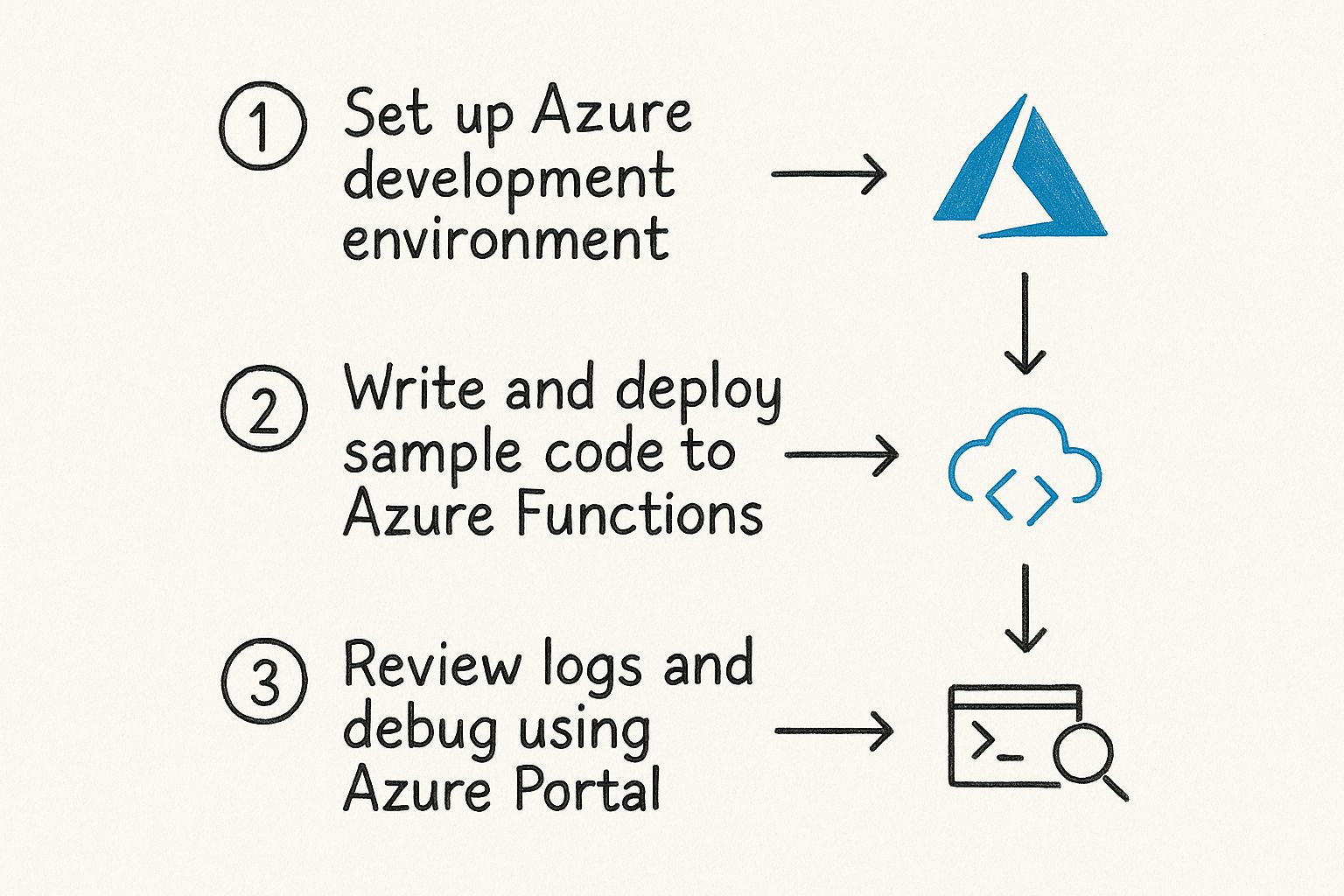
Mastery comes from repeating this cycle—setup, code, debug—with different Azure services until it becomes second nature.
To make your lab time count, give yourself specific, project-based goals. For instance:
- Week 1 Goal: Build a simple serverless API with Azure Functions that reads and writes data to a Cosmos DB database.
- Week 2 Goal: Create a web application, deploy it to Azure App Service, and secure it using Microsoft Entra ID for user authentication.
- Week 3 Goal: Containerize that web app, push it to Azure Container Registry, and run it on Azure Container Apps.
This project-based approach is far more powerful than just blindly following tutorials because it forces you to solve real problems and see how different Azure services work together.
Phase 4: Reinforce and Review Strategically
As you work through your labs and learning materials, you need a system to make the information stick. The sheer volume of services, commands, and concepts can feel overwhelming. This is where smart learning techniques come into play.
One of the most effective methods is spaced repetition, which involves reviewing information at increasing intervals to fight the "forgetting curve." Flashcards are a perfect tool for this, as they let you break down complex topics into bite-sized, testable pieces. If you want to get the most out of your study time, you can learn more about how to use flashcards for studying and apply those ideas to your AZ-204 prep.
As you get closer to your exam date, practice exams should become your best friend. The goal isn't just to get a high score. It's to meticulously analyze your results. For every single question you get wrong, dig deep to understand why. Was it a gap in your knowledge? Did you misread the question? This targeted review process is how you turn your weaknesses into strengths, ensuring you walk into that test center feeling prepared and confident.
Navigating Exam Day and Keeping Your Certification Current
https://www.youtube.com/embed/jXV2uZQycZY
You've put in the hard work and long hours. Now comes the final step: exam day. How you handle this day—and what you do after you pass—is just as crucial as all the studying you did to get here. It’s all about having a solid plan for the test itself, managing the clock under pressure, and knowing exactly how to make the most of your new certification.
Having a clear game plan for exam day takes the guesswork out of the equation, letting you focus all your mental energy on the questions. The first real decision you'll make is when and where to take it. You have two main options: taking it online from the comfort of your home or heading to an official testing center.
Choosing Your Exam Environment
This choice really boils down to your personal comfort and what kind of environment helps you perform your best. There's no right or wrong answer, just what's right for you.
-
Online Proctored Exam: The big draw here is convenience. You get to take the exam in a familiar space. But this comes with some strict rules. You'll need a totally quiet, empty room—no one can come in or out. A solid internet connection and a working webcam are non-negotiable. The check-in process is also pretty thorough, requiring photos of your ID and a 360-degree view of your testing room.
-
Official Test Center: Going to a test center means you walk into a controlled environment built for testing. They provide the computer and a stable internet connection, so you don't have to worry about technical glitches on your end. The only real downside is that you have to travel to a physical location at a specific time.
No matter which path you choose, you absolutely need a valid, government-issued ID. A little bit of anxiety is completely normal, but being prepared for the logistics helps a ton. For more tips on keeping your cool, check out our guide on how to overcome exam anxiety.
Tackling the Exam Questions
The AZ-204 exam isn't about memorizing facts; it’s designed to see if you can actually do the work. You'll see a mix of question types, from multiple-choice and drag-and-drop to the more intensive case studies and hands-on labs.
Case studies are where they give you a detailed business scenario and a set of technical problems to solve, followed by several related questions. The hands-on labs are the real test, though. You'll be dropped into a live Azure portal and asked to build or configure something specific. It’s where the rubber meets the road.
Time management is everything. Don't let yourself get stuck on one tough question. It's a classic trap. If you're spinning your wheels, flag it for review and move on. You can always circle back later if you have time left.
Life After Passing: What Happens Next?
Congratulations, you passed the AZ-204! Your journey as a certified Microsoft Azure Developer is just getting started. Within a couple of days, keep an eye on your inbox for an email from Microsoft. It'll have instructions on claiming your official digital badge from a platform like Credly.
Claim that badge right away! Add it to your LinkedIn profile, your resume, and even your email signature. It's a simple, verifiable way to show your professional network and any potential employers what you can do.
As of 2025, the AZ-204 continues to be one of the top three most in-demand Azure certifications. Passing it proves you have a high level of skill in designing, building, and optimizing cloud applications, which can open a lot of doors for your career.
The Annual Renewal: A Commitment to Growth
Your certification is valid for one year. To keep it active, you'll need to pass a free renewal assessment online. Don't think of this as a chore; it's actually a great opportunity. Microsoft provides free learning materials that cover all the latest Azure features relevant to the AZ-204.
Think of the renewal as your annual commitment to staying sharp. Cloud technology changes fast, and this process ensures your skills stay relevant and valuable, cementing your status as a knowledgeable Azure developer.
Your Top AZ-204 Questions, Answered
Thinking about taking the plunge and going for the Microsoft Azure Developer certification? It’s a big step, so it’s only natural to have a few questions swirling around. You want to know if it's the right move for your career, your current skills, and the time you'll need to invest.
This section tackles the most common questions we hear from developers weighing the AZ-204. We'll give you straight, honest answers to help you understand what the exam really entails and how it can impact your career. The goal is to give you the clarity you need to move forward with confidence.
How Much Coding Experience Do I Really Need?
Microsoft officially recommends one to two years of professional development experience, but let's be real—what matters is proficiency, not just time in the chair. You need to be comfortable writing, debugging, and deploying code in at least one Azure-supported language, like C# or Python.
This exam isn't just about theory. You'll face hands-on labs and be expected to understand code snippets related to Azure SDKs, REST APIs, and various command-line tools. You have to be able to read the code and know what it's trying to do.
- If your programming fundamentals are solid but you're new to the cloud, your best bet is to dive deep into hands-on labs. This is how you'll build the Azure-specific muscle memory you need.
- On the flip side, if you know your way around the Azure portal but your coding is a bit rusty, you should dedicate serious time to coding exercises and brushing up on your language of choice.
At the end of the day, it's all about your ability to apply code to solve real-world problems in an Azure environment.
I’m Already an Experienced Developer. Is the AZ-204 Worth It?
Absolutely. For a developer who’s been around the block, the AZ-204 is more than just another line on a resume. Think of it as a strategic tool for validating and broadcasting your expertise in a way that gets you noticed.
First, it’s concrete proof of your skills on a specific, high-demand cloud platform. That kind of validation makes you highly visible to recruiters, hiring managers, and even leaders within your own company who are looking for people to lead important projects.
It takes you from saying "I can do that" to having a credential that says "I have proven I can do that." That's a powerful shift that builds trust and opens doors to bigger and better opportunities.
Second, the process of studying for the exam is incredibly valuable in itself. It forces you to explore corners of Azure you might not touch in your day-to-day work—things like advanced security configurations, different storage solutions, or specific performance monitoring techniques. This makes you a far more versatile and well-rounded engineer.
How Does the AZ-204 Stack Up Against the AWS Certified Developer?
Both the AZ-204 and the AWS Certified Developer Associate are top-tier certifications. They serve the same purpose but for the two giants of the cloud world. Which one is "better" for you usually comes down to your current company's tech stack or the kind of companies you want to work for.
Here’s a quick side-by-side look:
| Aspect | Azure Developer (AZ-204) | AWS Developer Associate |
|---|---|---|
| Ecosystem Focus | Microsoft Azure platform | Amazon Web Services platform |
| Common Scenarios | A natural fit for organizations deep in the Microsoft ecosystem (.NET, Microsoft 365). | A massive footprint in startups and a huge variety of other industries. |
| Core Concepts | Tests the same fundamentals: compute, storage, security, and monitoring. | Also tests core cloud concepts, just with AWS-specific services and tooling. |
The reality is, many large companies are now multi-cloud, making skills in both platforms incredibly valuable. Earning either certification is a huge win, but having familiarity with both can make you a truly standout candidate in a competitive market.
How Can I Use the Renewal Process to My Advantage?
Don't think of the annual certification renewal as a chore. It’s a free, guided learning opportunity. Each year, Microsoft releases a curated set of Microsoft Learn modules covering the newest features and updates relevant to your certification.
Instead of cramming for the renewal assessment at the last minute, try to build a habit of continuous learning. Block off a couple of hours each quarter to go through the new material and play around with the new features in your own dev environment.
This keeps your skills sharp all year long, and when it’s time for the open-book renewal assessment, it’s a breeze. By embracing this cycle, you not only keep your Microsoft Azure Developer certification active but also ensure you're constantly bringing the most current and valuable skills to your team.
Ready to stop thinking about the exam and start preparing with confidence? AZ-204 Fast gives you everything you need—interactive flashcards, dynamic practice exams, and detailed progress tracking—to master the material without wasting time. Conquer the AZ-204 exam by visiting us at AZ-204 Fast.
Leave a Reply