
If you're a developer looking to prove your cloud skills, an Azure certification is much more than just another line on your resume. Think of it as a serious investment in your career. This guide will walk you through exactly what that means, covering everything from the exam itself to how it can genuinely boost your professional life.
Why an Azure Certification Matters for Your Developer Career

As businesses everywhere shift their operations to the cloud, having skills you can prove is no longer a "nice-to-have"—it's a must. An Azure certification sends a clear message to employers: you have the proven expertise to design, build, and manage applications on one of the world's leading cloud platforms.
Experience is great, but a certification is documented proof of your know-how. It tells a hiring manager that you've mastered the specific, real-world skills needed to solve modern problems using Azure.
For a quick overview of the key certification, here are the essential details.
Azure Developer Certification At a Glance
| Attribute | Details |
|---|---|
| Certification Name | Azure Developer Associate |
| Exam Code | AZ-204: Developing Solutions for Microsoft Azure |
| Target Audience | Cloud developers with 1-2 years of professional development experience |
| Skills Measured | Developing Azure compute solutions, storage, and security; monitoring, troubleshooting, and connecting to Azure and third-party services |
| Prerequisites | None, but proficiency in an Azure-supported language (like C# or Python) is highly recommended |
| Validity | 1 year (with free annual renewal assessment) |
This certification is your primary goal as a developer focused on building solutions in Azure.
The Growing Demand for Azure Skills
The massive move to cloud services has created a noticeable skills gap in the job market. Companies are scrambling to find developers who don't just write code but can also deploy, manage, and optimize it within a cloud environment. This is exactly where an Azure certification for developers sets you apart.
The demand isn't just growing; it's exploding. Some industry reports point to a staggering 200% year-over-year growth in demand for roles requiring Azure skills. This is a direct consequence of more companies trusting Azure for its scalability and security. You can dig deeper into this trend by checking out the latest findings on Azure skill demand.
This isn't a temporary fad. As more enterprises double down on Azure, the need for certified professionals will only get more intense, making your expertise incredibly valuable.
Tangible Career Benefits
Beyond simply meeting market demand, earning a certification opens up real, tangible career opportunities. It’s not about collecting digital badges; it's about unlocking better projects, landing more senior roles, and earning a higher salary.
Here are some of the key benefits you can realistically expect:
- Increased Earning Potential: Certified professionals often earn more than their non-certified colleagues because their skills are verified and highly sought after.
- Enhanced Job Prospects: Many companies use certifications as a filter when hiring. Having one automatically moves your resume toward the top of the stack.
- Greater Professional Credibility: The credential backs up your expertise, giving you more confidence and authority when you're discussing cloud architecture with teammates or clients.
- Future-Proofing Your Career: Technology changes fast. A certification shows you're committed to keeping your skills sharp and staying relevant.
A certification is a documented proof that you know what you are doing, in the field of expertise that you are into. It separates you from the crowd and shows you are serious about your craft.
Ultimately, putting in the time to get certified is a smart, strategic move. It positions you as a developer who's ready to lead in the cloud era, making you an invaluable part of any team.
Navigating the Azure Developer Certification Path

Let's be honest, the Microsoft certification landscape can feel like staring at a complex subway map. There are dozens of lines branching off in every direction. For developers, the goal is to find the one track that's all about hands-on, code-first work. That track leads directly to the Microsoft Certified: Azure Developer Associate certification, which you earn by passing the AZ-204 exam.
It helps to think of Microsoft’s certifications as a tiered system, each level validating a different degree of expertise. This structure gives everyone a clear path forward as they get deeper into the cloud.
-
Fundamental Level: This is your ground floor. Think of the AZ-900 Azure Fundamentals exam. It's built to confirm you understand basic cloud concepts and core Azure services, making it perfect for anyone just starting with the cloud, no matter their job title.
-
Associate Level: This is where we find the Azure Developer Associate (AZ-204). It’s a role-based certification designed for people who are actively designing, building, testing, and maintaining cloud applications. It's the main destination for any developer writing code that will run on Azure.
-
Expert Level: At the top of the pyramid are certifications like the DevOps Engineer Expert. These are meant for seasoned pros who have a deep and broad command of complex cloud solutions.
The Azure Developer Associate certification consistently ranks among the most valuable credentials out there. It’s a non-negotiable step for any developer looking to prove they’ve moved beyond the basics and are ready to build real-world solutions on Azure.
Who Is the AZ-204 Certification For?
So, is the AZ-204 the right move for you? This certification is laser-focused on developers. If you spend your days involved in every phase of cloud development—from hashing out requirements to deployment and ongoing maintenance—you're exactly who this exam is for.
You're a perfect candidate if your job involves working alongside solution architects, DBAs, and administrators to bring a cloud application to life. The AZ-204 is designed to validate the very skills you’re already using.
The AZ-204 is for software developers with subject matter expertise in designing, building, testing, and maintaining cloud applications and services on Microsoft Azure. It's less about theory and all about practical, hands-on implementation.
Understanding the Real Prerequisites
One of the first questions people ask is about prerequisites. Officially, there aren't any. You don't have to pass the AZ-900 before taking the AZ-204, though it can certainly be a solid foundation to build upon.
The real "prerequisites" are all about practical experience. Microsoft suggests that anyone taking this exam should have one to two years of professional development experience, including hands-on time spent working with Azure.
Specifically, you should be comfortable with:
- A Supported Programming Language: You need to be proficient in a language Azure supports, like C#, Python, JavaScript, or Java. The exam will throw code snippets and SDK questions at you.
- Azure Services: You need a working knowledge of key Azure services. This means getting your hands dirty with the Azure SDKs, Azure PowerShell, and the Azure CLI.
This focus on what you can do rather than what exams you’ve passed is what makes this Azure certification for developers so valuable. It’s not about collecting badges; it's about proving you can build. If you need a little more clarity on the whole process, our guide on how to get Microsoft certified breaks down the entire journey.
What's Actually on the AZ-204 Exam?
If you want to pass this Azure certification for developers, simply reading the official exam guide won't cut it. You need to get your hands dirty and understand how those high-level topics translate into real-world code and deployment tasks. Let's dig into what the AZ-204 really tests.
Think of the exam domains less like chapters in a textbook and more like a construction plan for a modern cloud application. Each section covers a critical stage of the development lifecycle, from writing the code that runs your app to figuring out the best way to store its data and keep it all secure and running smoothly.
The AZ-204 exam is your chance to prove you can build on the fundamentals. As the official Microsoft path shows, it's the core developer certification that sits right after the foundational AZ-900.
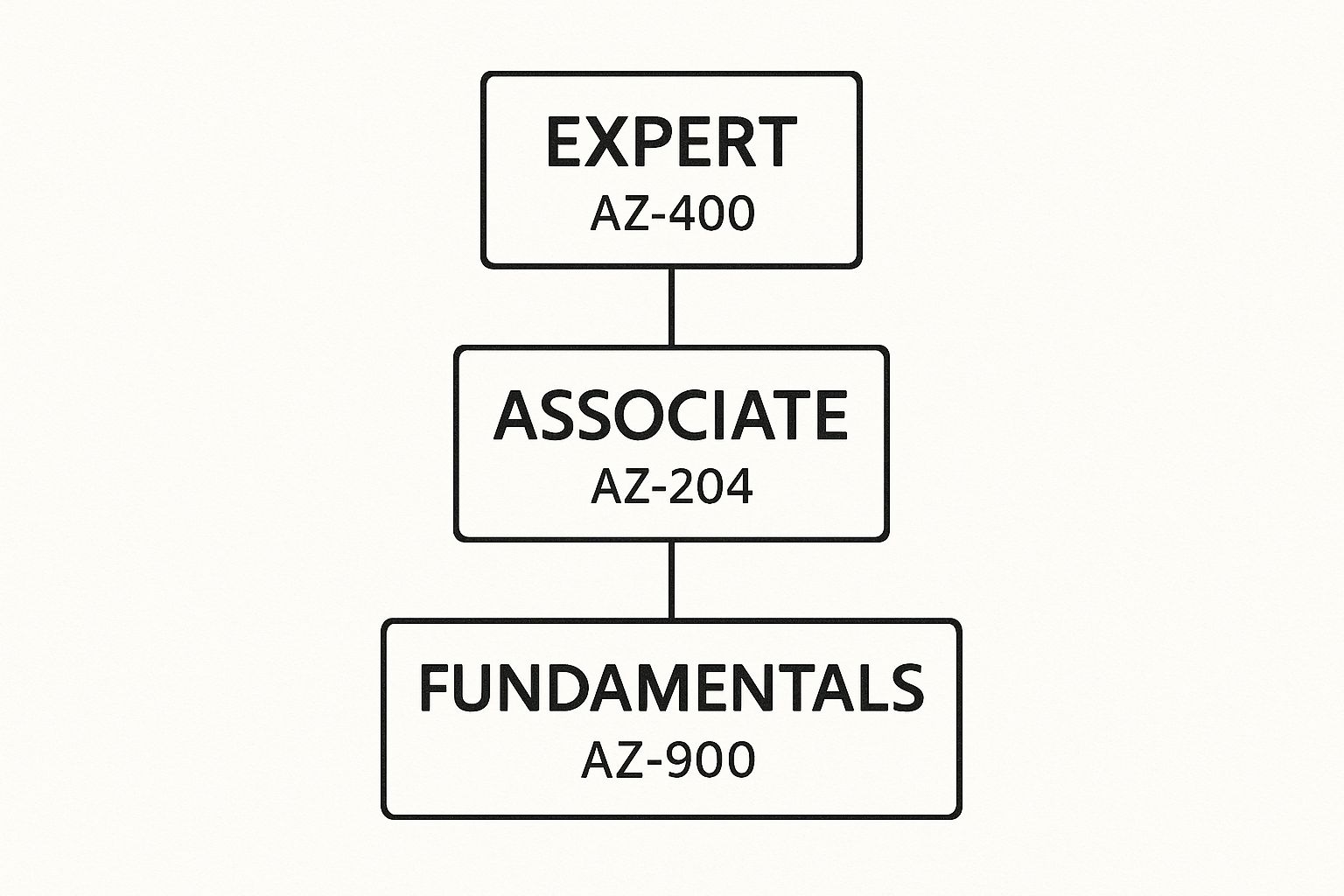
This path makes it clear: AZ-900 shows you know what Azure is, but the AZ-204 proves you know how to build with it.
The 5 Core Skill Areas of the AZ-204 Exam
The exam is broken down into five key skill areas. Pay close attention to the weighting of each one—it's your roadmap for where to focus your study time. Some topics are a much bigger piece of the pie, and that's a direct reflection of what you'll be doing day-to-day as an Azure developer.
Here’s a look at how the exam is structured.
AZ-204 Exam Domain Weighting
The table below outlines the official skill areas measured on the AZ-204 exam and their relative importance, helping you prioritize your study efforts.
| Exam Domain (Skill Area) | Percentage of Exam |
|---|---|
| Develop Azure compute solutions | 25–30% |
| Develop for Azure storage | 15–20% |
| Implement Azure security | 20–25% |
| Monitor, troubleshoot, and optimize Azure solutions | 15–20% |
| Connect to and consume Azure services and third-party services | 15–20% |
As you can see, compute and security make up a huge portion of the exam. Now, let's dive into what these domains actually mean in practice.
Domain 1: Develop Azure Compute Solutions (25–30%)
This is the big one, accounting for almost a third of your final score. "Compute" is just the cloud term for where your code actually executes. This domain is all about knowing how to build and deploy applications using Azure’s core hosting services.
For example, you’ll need to know:
- Azure App Service: When is deploying a web app to an App Service plan the right move? You should be comfortable configuring features like deployment slots to pull off a "blue-green" deployment, letting you test a new version of your app in production with zero downtime for users.
- Azure Functions: How would you build a serverless API that automatically runs whenever a new file is dropped into Blob Storage? This means writing the function code, connecting the trigger, and managing its configuration.
- Container-based Solutions: The exam will test your ability to package and run applications in containers using services like Azure Container Instances (ACI) or Azure Kubernetes Service (AKS). A classic scenario is creating a Dockerfile for an API and deploying it to ACI.
The real skill here is choosing the right tool for the task. It's about understanding the trade-offs between a traditional web app (App Service), an event-driven piece of logic (Azure Functions), and a containerized microservice (ACI/AKS).
Domain 2: Develop for Azure Storage (15–20%)
Every useful application needs to store data somewhere. This domain tests your knowledge of how to manage data effectively in Azure. It’s about more than just picking a database; it’s about understanding the different storage models and when each one makes sense.
This section breaks down into two main types of storage:
- Non-Relational Storage: The exam puts a heavy emphasis on Azure Cosmos DB and Azure Blob Storage. You must know how to work with both using the Azure SDK. For instance, can you write the C# or Python code to upload a user’s profile image to Blob Storage while saving their user data as a JSON document in Cosmos DB?
- Relational Storage: While it’s a smaller focus, you still need a working knowledge of Azure SQL.
A key part of this domain is matching the data to the right storage service. You wouldn’t stuff large image files into a relational database, and you wouldn't rely on Blob Storage for complex, query-heavy transactional data.
Domain 3: Implement Azure Security (20–25%)
Security isn't just for the ops team anymore—it's a fundamental part of a developer's job. This domain, weighted almost as heavily as compute, tests your ability to lock down your applications using Azure's native security tools.
Practical skills you'll be tested on include:
- User Authentication and Authorization: This is all about implementing user sign-in flows using the Microsoft Identity Platform. You should know how to protect an API so that only authenticated users with the right permissions can call it.
- Managed Identities: You’ll need to know how to give an Azure resource (like your web app) its own identity. This lets it securely talk to other Azure services (like a database or Key Vault) without you ever having to hardcode secrets or connection strings in your app.
- Secure Configuration: This covers managing your application's secrets with Azure Key Vault. Instead of putting a database password in a config file, you store it in Key Vault and let your application fetch it securely when it starts up.
Domain 4: Monitor, Troubleshoot, and Optimize Azure Solutions (15–20%)
Your job isn't done once the code is deployed. This section is about everything that happens next: making sure your application is fast, reliable, and not costing a fortune to run. You have to know your way around Azure's monitoring tools to find and fix issues.
This involves:
- Application Insights: You need to know how to add the Application Insights SDK to your code to automatically send telemetry data. This is how you track errors, spot performance bottlenecks, and build dashboards to see your app's health at a glance.
- Caching: Caching is a developer's best friend for optimization. You'll need to understand when and how to implement a service like Azure Cache for Redis to dramatically speed up data retrieval and take pressure off your backend databases.
Mastering these skills shows you're ready not just to build, but to own and maintain robust cloud solutions. It proves you're the kind of developer any team would want for their next Azure certification for developers project.
Building Your Personal AZ-204 Study Plan
Let's get one thing straight: passing the AZ-204 isn't about memorizing a bunch of abstract facts. It’s a hands-on exam for a hands-on job. Your success hinges on having a solid, structured plan that fits your experience level, how you learn best, and the time you have available. This is your personal roadmap to walking into that test center with confidence.
Think of it like any development project. You wouldn't just jump in and start hammering out code without a spec or a plan, right? The same logic applies here. A good study plan keeps you on track and ensures you cover all the critical areas without feeling completely overwhelmed.
The real goal isn't just a piece of paper; it's proving you have the practical skills that make a great Azure developer. That means your study plan has to be all about doing, not just reading.
Core Components of a Winning Study Plan
Your preparation should be built on a few key pillars. By mixing and matching these resources, you'll get a much more complete picture, moving from knowing the theory to actually applying it.
-
Official Microsoft Learn Path: This is your ground truth. The AZ-204 Learning Path on Microsoft Learn is expertly put together, completely free, and maps directly to what's on the exam. Start here to understand the "what" and "why" behind every topic.
-
Hands-On Labs: Theory will only get you so far. You absolutely must spend serious time inside the Azure portal. Grab a free Azure account and start working through the labs on Microsoft Learn and their associated GitHub repos. This is where the knowledge sticks.
-
Practice Exams: Getting a feel for the real test environment is non-negotiable. Quality practice exams get you comfortable with the question styles, the pressure of the clock, and help you find your weak spots before the big day.
The Learn-by-Doing Approach
The single most effective way to prep for this Azure certification for developers is to actively build things. Don't just read about Azure Functions—spin one up and deploy it. Don't just learn the theory of Cosmos DB—write some code that actually connects to it and moves data around.
Your guiding principle should always be: "Can I build this?" If you just read a module on implementing managed identities, your very next move should be to open Visual Studio Code, write a small app, and make it work. This process of active recall cements knowledge in a way passive reading never will.
This hands-on mentality is especially critical for the lab-based questions on the exam. They'll drop you into a live Azure environment with a list of tasks. There's no faking it there—you either know how to do it, or you don't.
A Sample 6-Week Study Schedule
How long you'll need depends on what you already know, but a six-week plan is a pretty realistic goal for most developers. Here’s one way you could break it down:
-
Week 1: Azure Compute Solutions (25-30%)
- Dive right into the biggest section of the exam.
- Your Mission: Deploy a web app to App Service, complete with staging slots. Build a simple serverless API with Azure Functions. Then, containerize a small app with Docker and run it on Azure Container Instances (ACI).
-
Week 2: Azure Storage & Security (15-20% & 20-25%)
- Time to tackle the next two most heavily weighted domains.
- Your Mission: Write code to push files to Blob Storage and query data in Cosmos DB. Then, implement user login using the Microsoft Identity Platform and lock down your app secrets with Azure Key Vault.
-
Week 3: Monitoring & Connecting Services (15-20% each)
- Focus on the remaining, but still crucial, domains.
- Your Mission: Integrate Application Insights into an app to catch errors. Speed things up by implementing Azure Cache for Redis. Connect two different services using Event Grid.
-
Week 4: Targeted Review and Practice
- Time for a reality check. Take your first full-length practice exam.
- Your Mission: Dig into your results to see where you struggled. Go back to the Microsoft Learn modules for those topics and, more importantly, redo the hands-on labs. This is also a great time to learn more about using flashcards for studying to drill the concepts you're shaky on.
-
Week 5: Deep Dive and Refinement
- Zero in on your one or two weakest domains from last week's practice test.
- Your Mission: Don't just reread the same material. Find different explanations on YouTube or technical blogs. Better yet, try to build a tiny project that relies heavily on those specific services. Take another practice exam at the end of the week to measure your progress.
-
Week 6: Final Review and Exam Prep
- Ease off learning new things. The goal now is to consolidate what you know.
- Your Mission: Review your notes, cheat sheets, and flashcards. Take one last practice test about 2-3 days before your exam date. The day before, just relax. Last-minute cramming will do more harm than good.
Remember, this is just a template. If you're a security guru but have never touched a container, shift your time accordingly. The real keys to success are consistency and a relentless focus on practical, hands-on application.
What to Expect on Exam Day and Beyond
Walking into your exam feeling prepared is about more than just knowing the material. It's also about understanding the process itself. When you know what’s coming, you can sideline the anxiety and focus on demonstrating your skills. Your journey to becoming a certified Azure developer really hits its stride on exam day and keeps going long after.
Let's talk about what the AZ-204 exam is actually like. Forget simple multiple-choice quizzes. This test is designed to mirror the real-world challenges you'd face as a developer working in the Azure ecosystem.
Understanding the Exam Format
The AZ-204 is built to test your practical ability, not just your book smarts. You’ll see a mix of question types, and while the exact blend changes, you can bank on running into these formats:
- Case Studies: Imagine being handed a detailed project brief. You'll get a business problem, a list of technical needs, and a set of constraints. Then, you'll have to answer a series of questions that require you to design and implement the right Azure solutions for that scenario.
- Hands-On Labs: This is where the rubber meets the road. You get dropped into a live Azure portal with a list of tasks to complete. This could be anything from configuring an App Service to provisioning a new Cosmos DB database. There’s no guessing here; you have to prove you can actually do the work.
- Standard Question Types: Of course, there are still traditional questions like multiple-choice, drag-and-drop, and fill-in-the-blanks. These are used to check your fundamental knowledge of core Azure services and concepts.
This blended format is precisely why the certification is so well-respected—it validates that you can apply what you know. It's also why so much of your preparation needs to be hands-on. If the thought of all this still has your stomach in knots, check out our guide on how to overcome exam anxiety for some practical tips.
Exam Logistics and Scoring
Booking your exam is simple and done right on the official Microsoft Learn certification page. The price for the Microsoft Azure Developer Associate exam has held steady at around $165 USD in the United States. While this can change a bit depending on your country and local taxes, it's a pretty standard fee for a professional Microsoft certification. Always double-check the official exam page for the most current pricing.
You need a score of 700 out of 1000 to pass the AZ-204. One of the best parts is that you usually get your results immediately after finishing the exam, so there's no waiting around to see if you've made the cut.
The Certification Lifecycle and Renewal
Passing the exam is a huge milestone, but in the world of cloud tech, standing still means falling behind. That's why your Azure Developer Associate certification is valid for one year. Think of this not as a hassle, but as a feature that keeps your credential meaningful.
To keep it active, you'll need to renew it annually by taking a free, online assessment through Microsoft Learn. This renewal isn't a full-blown exam; it’s a shorter, unproctored test that covers the most important Azure updates from the past year. This approach keeps you on top of your game and signals to employers that your expertise is current, making you a far more valuable professional.
Putting Your Certification to Work for Your Career
Passing the AZ-204 exam is a huge achievement, but don't think of it as the finish line. It's the starting gun. This certification is documented proof of your skills, and now it's time to make it work for you.
Your first move? Make it visible. You earned this, so don’t be shy. Get that Microsoft Certified: Azure Developer Associate badge on your LinkedIn profile, your resume, and even your email signature right away. Recruiters and hiring managers often use certifications as a first-pass filter, and this badge is your ticket past the velvet rope.
How to Showcase Your Expertise
Just listing the certification is fine, but telling a story with it is much better. When you're updating your professional profiles, don't just drop the credential in and call it a day. Connect it directly to what you can do.
Instead of simply writing "Microsoft Certified: Azure Developer Associate," weave it into your accomplishments:
- On Your Resume: Under a project description, you could write something like, "Built a scalable, event-driven data processing pipeline using Azure Functions and Cosmos DB, applying skills validated by my AZ-204 certification."
- In an Interview: When asked about your cloud experience, try this: "My hands-on experience is backed by my Azure Developer certification, where I had to demonstrate my ability to implement secure cloud solutions with Key Vault and Managed Identities."
This small change in framing transforms your certification from a static line item into a dynamic story of your capabilities. It shows people how you solve real-world problems.
"A certification is a documented proof that you know what you are doing, in the field of expertise that you are into. It separates you from the crowd and shows you are serious about your craft."
This kind of validation is exactly what top employers hunt for when building their cloud teams. It’s a powerful signal that you’ve invested in yourself and can be trusted to handle critical cloud development tasks from day one.
Charting Your Next Move in Azure
The Azure certification for developers journey doesn’t stop with the AZ-204. This Associate-level credential is a fantastic foundation, but it’s also a stepping stone to more advanced, specialized roles. It opens the door to Expert-level certifications that can seriously boost your career trajectory.
A natural next step for many Azure developers is the Microsoft Certified: DevOps Engineer Expert (AZ-400). The skills you just mastered for the AZ-204—like deploying compute solutions and managing security—are the perfect groundwork for understanding the bigger picture of a DevOps lifecycle, including continuous integration and delivery (CI/CD).
Here’s a simple roadmap for what comes next:
- Master Your Current Role: Get your hands dirty. Spend time applying your new AZ-204 skills in actual projects.
- Find Your Passion: Do you love optimizing deployment pipelines? The DevOps path might be a perfect fit. Or maybe you're drawn to architecture?
- Aim for the Expert Level: Once you've found your niche, target an Expert certification. This is how you become a go-to specialist and a senior leader in your field.
Ultimately, earning your Azure Developer certification is the start of an exciting new chapter. It's an investment that unlocks immediate opportunities and sets you on a path to becoming an indispensable cloud expert.
Frequently Asked Questions
When you start looking into getting an Azure certification for developers, a lot of questions pop up. Let's tackle some of the most common ones so you can map out your path with confidence.
What Is the Difference Between AZ-900 and AZ-204?
A great way to think about this is like learning to cook versus becoming a chef. The AZ-900 (Azure Fundamentals) exam is like learning your way around a kitchen. You learn what all the tools do—the oven, the mixer, the different knives—and understand the basic ingredients. It's the foundational knowledge anyone working with Azure should have.
The AZ-204 (Azure Developer Associate), on the other hand, is for the chef. It’s not just about knowing the tools; it's about using them to create a full meal. This exam tests whether you can actually write code, connect services, and build functional applications on the platform. For developers actively building things in Azure, the AZ-204 is the certification that truly matters.
Do I Need Programming Experience to Pass the AZ-204?
Yes, absolutely. This isn't a theoretical exam; it's designed for hands-on developers. You'll need at least 1-2 years of professional development experience to be comfortable with the material.
You should be fluent in at least one language that Azure supports well, like C#, Python, or JavaScript. The exam will throw code snippets at you, ask about specific SDKs, and might even include labs where you have to write code on the spot. Trying to tackle it without a solid coding background would be an uphill battle.
How Much Does the AZ-204 Exam Cost?
The standard price for the AZ-204 exam is $165 USD, but this can change a bit depending on where you live and local taxes. Before you book, it's always smart to check the official Microsoft certification page for the exact price in your region.
Don't forget to ask around at work, too. If your company is a Microsoft Partner, they often have programs or vouchers that can cover the exam fee.
Think of the cost not as an expense, but as an investment in your career. This certification is documented proof of your skills—a powerful tool that can open doors to new roles and better pay.
How Long Is the Azure Developer Certification Valid?
Your Azure Developer Associate certification is good for one year. Microsoft keeps this renewal cycle short because Azure changes so quickly, and this ensures your skills stay relevant.
To renew, you just have to pass a free, online assessment on the Microsoft Learn platform before your certification expires. It's a much shorter, unproctored test that covers what’s new and updated, so you can keep your credentials active without having to sit for the full exam all over again.
Ready to fast-track your preparation and pass with confidence? AZ-204 Fast provides all the tools you need—from interactive flashcards and dynamic practice exams to detailed progress analytics. Master the material efficiently and conquer the exam. Learn more at https://az204fast.com.
Leave a Reply